

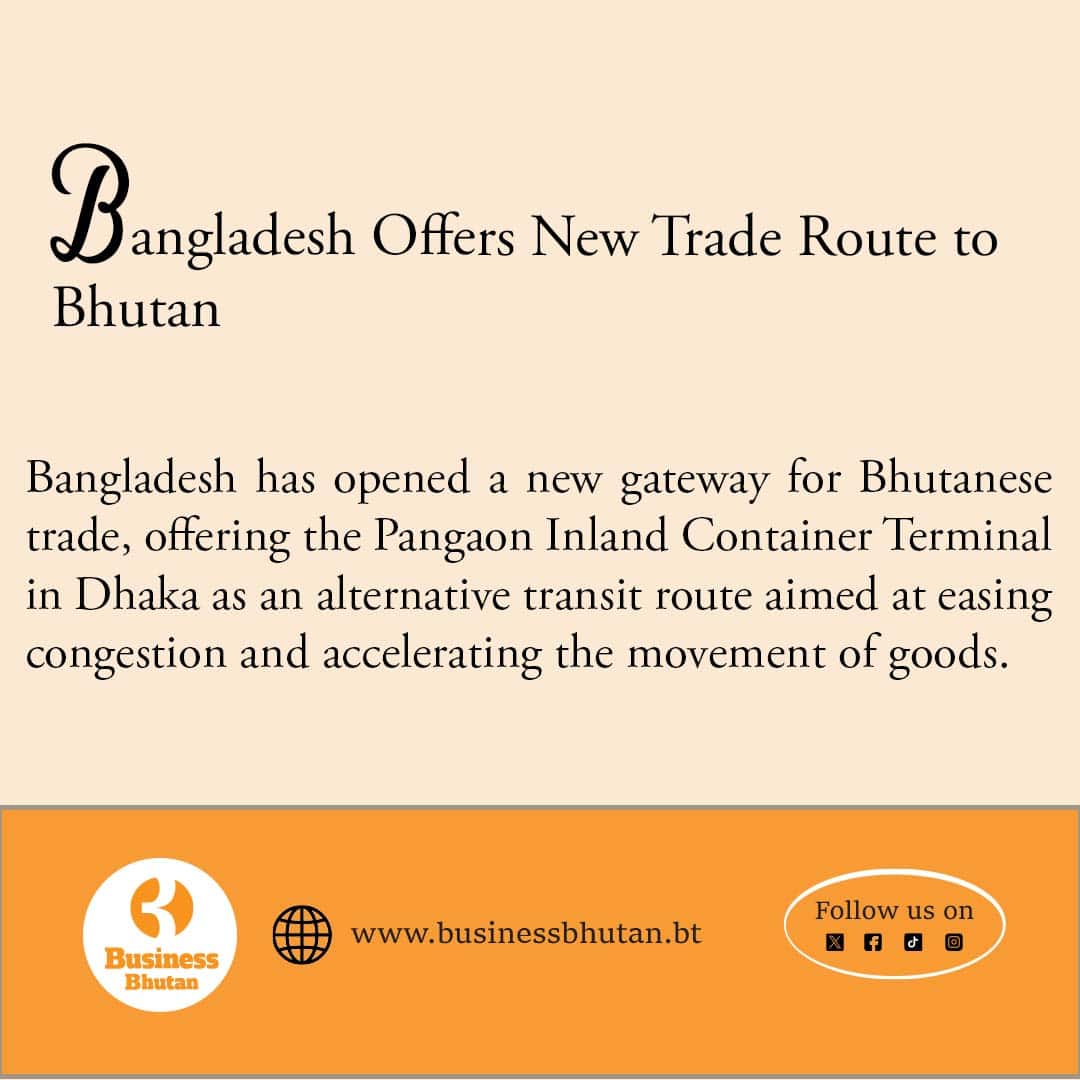
Bangladesh has opened a new gateway for Bhutanese trade, offering the Pangaon Inland Container Terminal in Dhaka as an alternative transit route aimed at easing congestion and accelerating the movement of goods.
The proposal emerged as a key outcome of the 10th Commerce Secretary-Level Meeting (CSLM) between the Royal Government of Bhutan and the Government of Bangladesh, where both sides reviewed progress and explored ways to deepen cooperation across trade, tourism, customs, standards, and cross-border facilitation.
Officials say the initiative reflects a broader push to improve trade efficiency, reduce logistical bottlenecks, and expand market access for both countries.
An official from Bhutan’s Ministry of Industry, Commerce and Employment (MoICE) said the move is part of ongoing efforts to strengthen bilateral economic ties.
“To enhance bilateral trade, the Bhutanese side has also proposed upgrading the existing Preferential Trade Agreement (PTA) to a full Free Trade Agreement (FTA),” the official said.
Bangladesh has agreed to carry out a feasibility study on the proposed upgrade. In parallel, both countries are working to expand the list of goods covered under the current PTA. Detailed negotiations are expected to take place at the technical level once both sides exchange their respective product lists.
The offer to use Pangaon port comes at a critical time, as Bhutanese traders continue to face logistical challenges at existing transit points.
Currently, Bhutan relies on facilities at Narayanganj, including the designated area at Khanpur. However, this space is undergoing renovation and has been experiencing congestion, limiting its efficiency and capacity.
In response, Bangladesh has proposed Pangaon as an alternative facility to support Bhutanese imports and exports. Located near Dhaka, the inland container terminal is expected to provide additional capacity and smoother handling of cargo.
Both sides have agreed to jointly assess the port before formally notifying it for Bhutan’s use. The assessment will focus on operational feasibility, cost-effectiveness, and the overall benefits for Bhutanese traders.
If the route proves viable, it could significantly reduce transit times. Officials estimate that cargo clearance could be brought down to about one week, compared to the current two to three weeks required through existing channels.
Such a reduction would have immediate benefits for Bhutanese exporters, particularly those dealing in perishable goods. Faster transit would help maintain product quality, reduce storage costs, and improve competitiveness in regional markets.
Bhutanese traders have long highlighted challenges in using regional transit routes through Bangladesh. These include limited parking space, congestion at port facilities, delays in cargo handling, and relatively high logistics costs.
The introduction of the Pangaon route is expected to ease some of these constraints while offering Bhutan an opportunity to diversify its trade routes.
“Bangladesh and Bhutan are working to improve connectivity by exploring more efficient transport routes,” the MoICE official said. “The use of Pangaon port could reduce congestion at existing facilities and improve the overall movement of goods.”
Beyond infrastructure, both countries are also focusing on improving coordination between customs authorities and transport agencies. Efforts are underway to streamline procedures, reduce delays, and address bottlenecks in cargo movement.
Regular reviews of these issues will be conducted through bilateral platforms such as the Joint Group of Customs and the Joint Trade and Technical Committee, ensuring that challenges are addressed in a timely and coordinated manner.
Another important development is the Agreement on the Movement of Traffic in Transit between Bhutan and Bangladesh, which is currently in its trial phase. Once fully operational, the agreement is expected to significantly enhance connectivity by providing clearer frameworks for the movement of goods across borders.
Trade between Bhutan and Bangladesh has grown steadily since the signing of the Bangladesh–Bhutan Preferential Trade Agreement in December 2020. The agreement came into force in July 2022 and has since played a key role in facilitating bilateral trade.
At present, the PTA provides duty-free access to 134 products—100 from Bangladesh and 34 from Bhutan. Both countries are now reviewing the agreement with the aim of expanding the list and identifying new areas for cooperation.
Bhutan’s exports to Bangladesh are largely driven by agriculture and natural resources. Key products include oranges, apples, ginger, and honey, as well as minerals such as limestone and gypsum. The country also exports industrial goods like iron and steel, wooden furniture, and certain processed food items.
Bangladesh, in turn, exports a wide range of manufactured and processed goods to Bhutan. These include ready-made garments, processed foods such as biscuits and juices, pharmaceuticals, household items, and raw materials like jute, leather products, and plywood.
This complementary trade structure has helped strengthen economic ties, with both countries benefiting from access to each other’s markets.
The introduction of the Pangaon route, along with ongoing efforts to upgrade trade agreements and improve logistics, signals a new phase in Bhutan-Bangladesh trade relations.
By reducing transit times, easing congestion, and expanding market access, the initiative has the potential to make trade more efficient and cost-effective for businesses on both sides.
While the success of the new route will depend on the outcome of technical assessments and its practical implementation, officials remain optimistic about its potential.
If effectively utilized, Pangaon could become a key transit hub for Bhutan, supporting its efforts to diversify trade routes and strengthen regional connectivity.
As both countries continue to build on their economic partnership, such initiatives are expected to play an increasingly important role in fostering stronger, faster, and more resilient trade links in the region.
Sherab Dorji
From Thimphu