

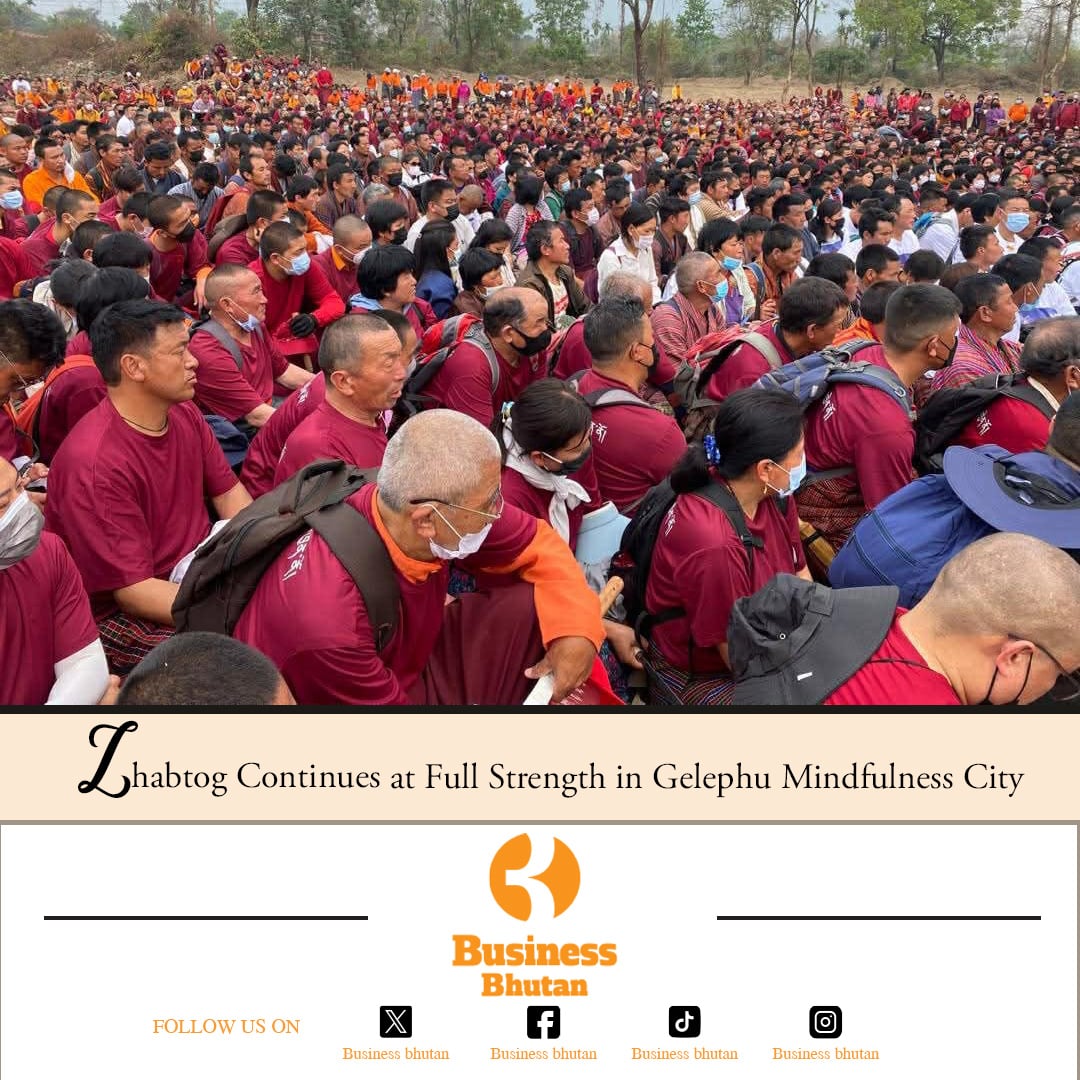
The spirit of Zhabtog continues to flow powerfully in Gelephu Mindfulness City (GMC), showing that the movement has grown far beyond a temporary national programme. Even after the fifth phase of the nationwide Zhabtog initiative concluded, the momentum did not slow.
Beginning March 8, 2026, a group of volunteers organised by the Pedling Yabsey Sum Kheyla arrived in Gelephu and worked for five days. During this period, they carried out landscaping work along the newly constructed Phulari Road and cleared vegetation while preparing the site for the Kurukulee Project at Serzhong.
Following this, Her Majesty the Gyaltsuen and other members of the Royal Family graced the salang tendrel of the Kurukulee center at Serzhong on March 13, 2026.
The center is proposed by Gangtey Trulku.
Meanwhile, the tradition of Zhabtog—voluntary service offered for the greater good—has always been woven into the very fabric of society. For generations, communities have gathered to build temples, repair farm roads, harvest crops, and support neighbours in times of hardship. It is a tradition rooted not in obligation, but in compassion and shared responsibility. Bhutanese have long understood that a society grows stronger when people work not only for themselves, but for one another.
Today, that ancient spirit has found an extraordinary new expression in the unfolding story of GMC. What is happening in Gelephu is not merely construction—it is the visible manifestation of national unity. Volunteers from every corner of the country and from every walk of life are arriving to contribute their labour, their time, and their devotion.
Pema Choeki, an engineer from Samdrup Jongkhar, described the Zhabtog programme as something truly exceptional. “This is extraordinary,” she said. “It is not just the scale of the work, but the spirit behind it. You see something rare and deeply moving—the entire nation coming together. From His Majesty the King to ordinary citizens, from revered monks to young students, from civil servants to farmers—everyone stands side by side, contributing what they can.”
Her words reflect a sentiment shared by many who have travelled to Gelephu to take part in this historic moment.
For Ugyen Tshering, a teacher from Kanglung, Zhabtog has taken a timeless Bhutanese tradition to new heights.
“Few could have imagined something like this,” he said. “People from across the country are arriving—not as workers hired for wages, but as volunteers offering their labour, their time, and above all their love. At the heart of this movement stands His Majesty the King, and beside him Her Majesty the Gyaltsuen Jetsun Pema, whose presence and compassion continue to inspire the Bhutanese people.”
Indeed, one of the most powerful symbols of the movement is the sight of Their Majesties themselves taking part in the voluntary work.
Pasang Dorji,a corporate professional who travelled to Gelephu to join the effort, described the moment he witnessed as something unforgettable.
“When a King lifts a spade and joins his people in voluntary work, something profound happens,” he said. “The distance between ruler and citizen disappears. What remains is a shared purpose—a collective dream. I saw this with my own eyes in Gelephu, and I felt an energy within me that I had never experienced before.”
The spirit of Zhabtog is also capturing the attention of visitors from beyond Bhutan.
Hunter, a visitor from Los Angeles in the United States, said the experience left him deeply inspired.
“Across the world we hear about conflict and division. There are wars in places like the Middle East and tensions everywhere,” he said. “But in Bhutan I saw something completely different—people rallying around their King for a national cause. I have never heard of anything like this anywhere else.”
His observation highlights something that many Bhutanese sometimes take for granted: the extraordinary relationship between the monarchy and the people.
Achal Maddapa, an Indian tourist had the same to say. “I saw pictures of Their Majesties working together with the people at Gelephu. It is simply out of the world, something we read about in fairy tales.”
Karma Tenzin, a recent Class XII graduate who volunteered in Gelephu, described the atmosphere as something almost impossible to explain.
“The moment I arrived, there was a feeling in the air—an energy that made the place feel different from anywhere else,” he said. “People were working everywhere: carrying materials, clearing land, preparing the ground for what will one day become a city unlike any other.”
What struck him most was the sense of unity.
“Strangers greeted each other like old friends,” he said. “People shared food, laughter, and stories. The sun was hot and the work was demanding, but no one seemed to mind. ”
Then came the moment that many volunteers say they will carry in their hearts forever.
“The sight of our King and Queen among us,” Karma Tenzin said. .Sangay Wangmo from Tsirang echoed the same sentiment.
“Seeing Their Majesties standing among the people, is something words cannot fully capture,” she said. “There was no distance, no formality. They were simply there—serving the nation alongside their people. For many of us, it stirred emotions we did not expect.”
Bhutan’s development story has always been shaped by a remarkable and unique social bond between the monarchy and the people. Throughout history, Bhutan’s Kings have dedicated their lives to the wellbeing of the nation, placing the happiness of the people above all else. In return, the Bhutanese people have responded with loyalty, trust, and love.
The Zhabtog movement unfolding in Gelephu today is perhaps one of the most powerful expressions of that bond.
Zhabtog, in Gelephu, has become more than a tradition. It has become a national expression of love.
Nidup Lhamo
From Thimphu