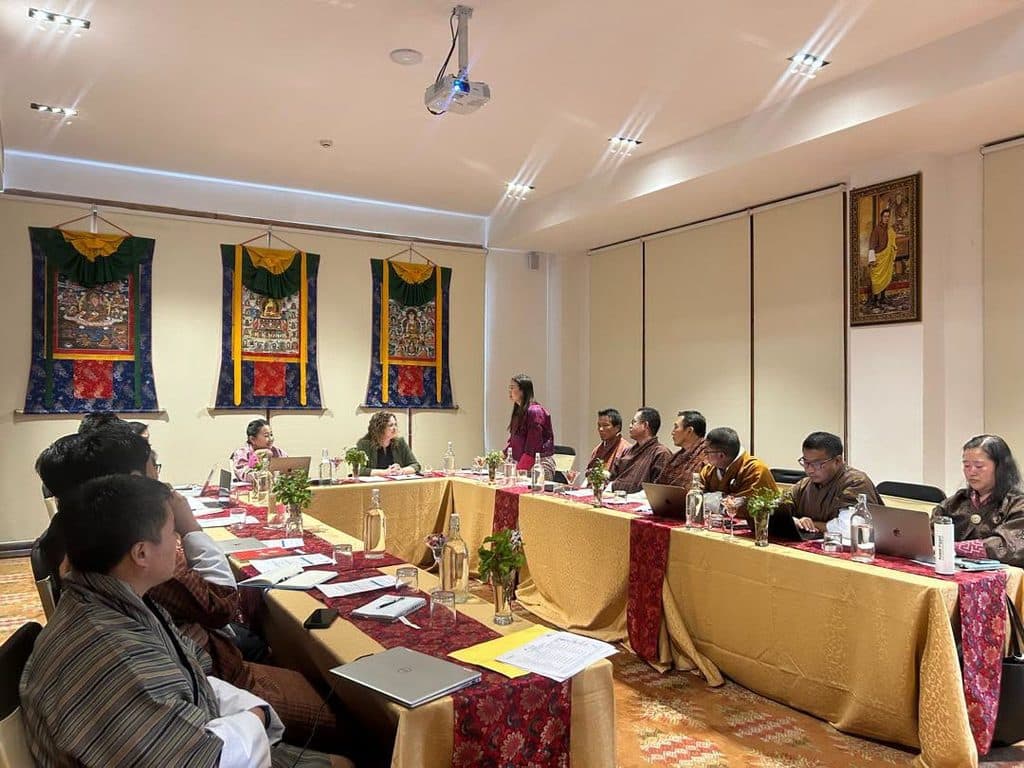
A national judicial dialogue in Bhutan is examining how courts can respond more effectively to the evolving nature of wildlife crime and illegal wildlife trade.
Judges from across the country have gathered in Thimphu for a workshop aimed at strengthening the legal response to environmental offences, particularly the growing complexity of illegal wildlife trade (IWT). The dialogue brings together members of the judiciary to reflect on emerging challenges, from cross-border trafficking to the use of digital platforms to trade wildlife products.
The programme is organised by the Bhutan National Legal Institute (BNLI) in collaboration with the Department of Forests and Park Services under the Ministry of Energy and Natural Resources and WWF Bhutan. It is being conducted in two batches—from March 11 to 13, 2026 and from March 16 to 18—with district and dungkhag court judges from all 20 districts participating.
Bhutan is widely recognised for its strong conservation policies and high forest cover, yet officials say wildlife crime continues to present evolving challenges shaped by regional and global dynamics. Illegal wildlife trade increasingly overlaps with organised criminal networks and is often facilitated by new technologies, including online marketplaces and social media.
In this context, the judiciary plays a pivotal role. Judges interpret wildlife laws, assess evidence and determine sentencing. Their decisions influence legal consistency, strengthen deterrence and reinforce the rule of law in environmental protection.
Rather than a conventional training programme, the workshop has been structured as an interactive dialogue, allowing judges to exchange experiences from cases they have handled and reflect collectively on emerging legal questions.
Discussions focus on trends in illegal wildlife trade, adjudicatory challenges and legal interpretations relevant to Bhutan’s conservation framework. Participants are also examining policy considerations that could strengthen enforcement and prosecution.
A major theme of the dialogue is the complexity of evidence in wildlife crime cases. Such cases often rely on specialised forms of proof, including forensic analysis, digital records and morphological identification of wildlife parts or plant species. Interpreting and evaluating this evidence can be challenging, particularly when investigations involve multiple agencies or transnational elements.
Judges are also discussing the quality of investigations and legal documentation presented to courts. Weak case files, incomplete evidence records or inconsistencies between investigation reports and legal provisions can undermine prosecutions even when offences are evident.
Officials say improving investigation procedures and documentation is therefore critical to ensuring that wildlife cases withstand judicial scrutiny.
The dialogue comes as wildlife-related violations remain a significant concern. According to the Ministry of Energy and Natural Resources, more than 6,500 wildlife-related offences were settled between 2020 and 2024.
Illegal timber extraction accounted for the largest share, with nearly 3,300 cases. Aquatic and fishing violations followed with more than 1,250 cases. Other offences included forest fires, timber misuse, illegal harvesting of non-wood forest products and poaching.
The number of cases peaked in 2020 at about 1,900 before declining steadily to around 750 in 2024. While the trend suggests improvements in compliance and enforcement, authorities caution that wildlife crime continues to evolve in form and scale.
Cross-border trafficking networks remain a concern in the Himalayan region, where wildlife products may be transported across remote landscapes and porous borders. Meanwhile, online platforms have created new avenues for illegal trade, enabling sellers and buyers to operate with greater anonymity.
Recognising these challenges, the government has recently introduced an Investigation and Legal Documentation Manual aimed at strengthening the preparation of wildlife crime cases. The manual provides guidance for investigators on evidence collection, documentation and case preparation to meet judicial standards.
The workshop also builds on earlier engagements between environmental agencies and the judiciary. Previous initiatives—including a judiciary awareness workshop in 2022 and discussions involving Bhutan’s environmental “green benches”—identified recurring issues such as discrepancies between legislation and subsidiary rules, evidentiary difficulties and inconsistencies in sentencing.
Participants also noted that wildlife crime can sometimes be perceived as a relatively minor offence, despite its serious ecological consequences.
For Bhutan, where environmental protection is embedded in national policy and governance principles, strengthening the legal response to wildlife crime carries wider significance. Judicial decisions not only determine the outcome of individual cases but also shape how conservation laws function in practice.
Sangay Rabten
From Thimphu