

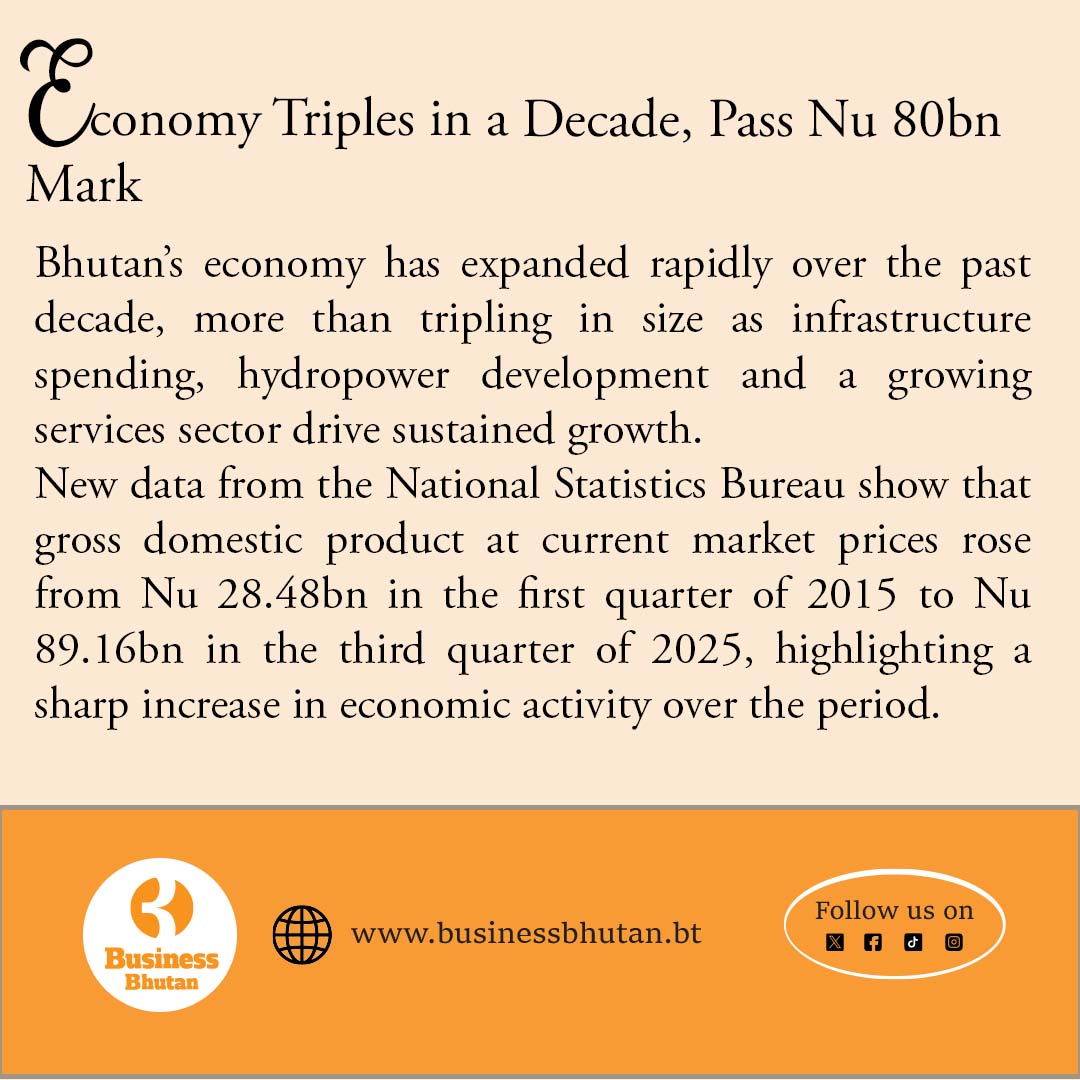
Bhutan’s economy has expanded rapidly over the past decade, more than tripling in size as infrastructure spending, hydropower development and a growing services sector drive sustained growth.
New data from the National Statistics Bureau show that gross domestic product at current market prices rose from Nu 28.48bn in the first quarter of 2015 to Nu 89.16bn in the third quarter of 2025, highlighting a sharp increase in economic activity over the period.
The figures chart the steady transformation of Bhutan’s economy, which has gradually shifted from a largely agrarian base toward one increasingly dominated by industry and services.
The upward trend is visible across the decade. Quarterly GDP crossed Nu 40bn in 2016, passed Nu 50bn in 2021, and exceeded Nu 70bn in 2023. Growth accelerated further thereafter, with output climbing beyond Nu 80bn in 2024 and approaching Nu 90bn by the third quarter of 2025—the highest level recorded in the dataset.
Despite global economic uncertainty and the lingering effects of the pandemic, Bhutan’s growth momentum remained strong in 2025. Real GDP, measured at constant prices, expanded 8.76% year-on-year in the fourth quarter of 2025, signalling robust economic activity.
At current market prices, GDP reached Nu 82.57bn in the fourth quarter of 2025, compared with Nu 73.46bn in the same quarter a year earlier. The increase of Nu 9.1bn represented growth of 12.39%, reflecting both higher production and price changes in the economy.
For the year as a whole, provisional estimates put GDP growth at 8.01% in 2025, an improvement on the 7.5% growth recorded in 2024. The figures suggest the economy is continuing to regain momentum after the pandemic-induced slowdown earlier in the decade.
Behind the headline numbers lies a clear shift in the structure of Bhutan’s economy.
Among the three main sectors—agriculture, industry and services—the industry sector recorded the strongest expansion. Industrial output grew 18.94% year-on-year in the fourth quarter of 2025, sharply higher than the 12.95% growth seen in the same period of 2024.
Much of that growth was powered by the electricity and construction subsectors, both central pillars of Bhutan’s development strategy. Hydropower generation remains one of the country’s most important economic engines, while large infrastructure projects and construction activities linked to public investment continue to stimulate industrial output.
Gross value added (GVA) from the industrial sector was estimated at Nu 26.43bn, accounting for 32.01% of GDP in the fourth quarter of 2025. That share has increased from 29.57% a year earlier, suggesting industry is gradually claiming a larger role in the economy.
Even so, the services sector remains Bhutan’s largest economic contributor.
Services—ranging from tourism and transport to trade, finance and public administration—accounted for 50.77% of GDP in the fourth quarter of 2025, with an estimated GVA of Nu 41.92bn.
Growth in the sector reached 4.88% year-on-year, somewhat slower than the 8.75% expansion recorded in the same quarter of 2024. Nevertheless, the sector’s dominance reflects Bhutan’s gradual transition toward a service-oriented economy, a pattern common among developing countries as incomes rise and economic structures evolve.
The agriculture sector, though vital for rural livelihoods, contributes a smaller share to national output.
Agricultural output expanded 4.56% year-on-year in the fourth quarter of 2025. The sector generated Nu 14.22bn in GVA, representing 17.22% of GDP. That share has edged down from 17.82% in the same quarter of 2024, underscoring the gradual shift of economic activity toward industry and services.
Even with its declining share in GDP, agriculture remains crucial for food security, employment and income generation in rural areas.
The decade-long expansion also reflects Bhutan’s recovery from the economic shock caused by the pandemic.
Economic output fell sharply in the second quarter of 2020, when GDP dropped to Nu 40.77bn as global travel restrictions disrupted tourism, trade and construction activity. Recovery gathered pace from 2022 onward, with GDP surpassing Nu 60bn by 2023 and accelerating further in the following years.
The reopening of the tourism sector, renewed construction activity and stronger domestic demand all contributed to the rebound.
Taken together, the data highlight several structural trends shaping Bhutan’s economy. Industrial expansion—driven largely by hydropower and construction—continues to play a central role, while services such as tourism and finance are steadily gaining importance.
At the same time, policymakers face the challenge of broadening the country’s economic base.
Hydropower exports remain a cornerstone of Bhutan’s growth model, but economists have long emphasised the need to diversify into new sectors and strengthen productivity across the economy.
Maintaining momentum will depend on continued investment in infrastructure, human capital and private-sector development. Expanding tourism, developing niche agricultural products and encouraging innovation in services are among the strategies often cited as pathways to diversification.
For now, the numbers tell a largely positive story.
With GDP expanding rapidly and the economy now worth nearly Nu 90bn per quarter, Bhutan has entered a new phase of economic scale. Whether that growth can be sustained—and spread more evenly across sectors—will shape the kingdom’s development in the decade ahead.
Tashi Namgyal
From Thimphu