

Money sent home by Bhutanese abroad surged in 2025, helping swell the country’s foreign-exchange reserves and providing a rare bright spot in an otherwise cautious economic landscape.
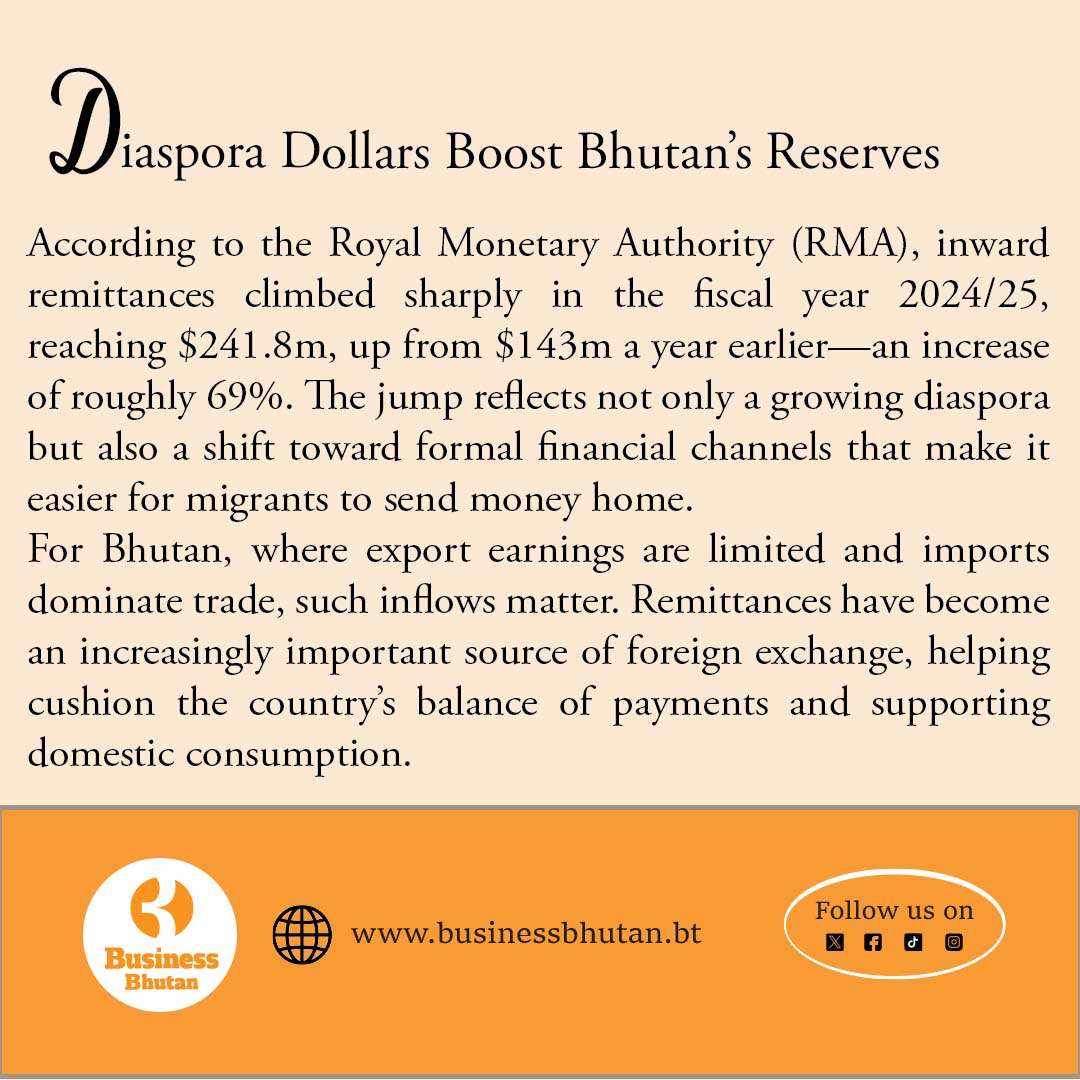
According to the Royal Monetary Authority (RMA), inward remittances climbed sharply in the fiscal year 2024/25, reaching $241.8m, up from $143m a year earlier—an increase of roughly 69%. The jump reflects not only a growing diaspora but also a shift toward formal financial channels that make it easier for migrants to send money home.
For Bhutan, where export earnings are limited and imports dominate trade, such inflows matter. Remittances have become an increasingly important source of foreign exchange, helping cushion the country’s balance of payments and supporting domestic consumption.
Much of the recent growth has been driven by improved remittance infrastructure. The central bank has encouraged the use of official banking channels through initiatives such as the Remit Bhutan programme, while partnerships between Bhutanese banks and overseas financial institutions have lowered transfer costs and improved reliability.
These efforts have nudged more Bhutanese living abroad to abandon informal methods of transferring money—such as carrying cash or relying on personal networks—in favour of regulated digital platforms. The result has been a surge in recorded transfers.
Geography also tells a story about Bhutan’s changing migration patterns. The largest share of remittances now originates from Bhutanese living in Australia, reflecting a sharp rise in students and workers there in recent years. The United States, Kuwait, the United Kingdom and Canada follow as other significant sources.
These flows underscore the growing economic ties between Bhutan and its diaspora communities, many of whom left the country in search of education or employment opportunities. For families back home, the money often helps cover daily expenses, education fees and housing costs.
While money flowing in has surged, the reverse direction has moved the other way.
Outward remittances—funds sent from Bhutan to other countries—totalled $58.1m in fiscal year 2024/25, a 22% decline from the previous year. These payments typically cover imported services, overseas education expenses and remittances sent by foreign workers employed in Bhutan.
More than 90% of outward remittances are directed to India, largely by Indian labourers working in Bhutan’s construction and manufacturing sectors.
That shift reflects broader adjustments in Bhutan’s economy, where construction activity has moderated following earlier expansion and tighter financial conditions.
Together, these trends—rising inflows and falling outflows—have strengthened Bhutan’s external position. The country’s gross international reserves reached $800.3m as of June 2025, according to the central bank.
That figure is comfortably above Bhutan’s constitutional requirement to maintain reserves sufficient to cover at least 12 months of essential imports. Current holdings can finance roughly 15.9 months of such imports, providing policymakers with a significant financial buffer.
Of the total reserves, $629.8m is held in convertible currencies, while $170.4m is denominated in Indian rupees—equivalent to about INR 14.6 billion. The reserves also include Special Drawing Rights allocations and Bhutan’s reserve tranche position with the International Monetary Fund, which together account for a small share of total holdings.
Compared with June 2024, Bhutan’s reserves have risen by around 28%.
Several factors lie behind the increase. Tourism earnings have recovered as global travel normalised after the pandemic-era slump, bringing much-needed foreign currency into the country. At the same time, remittance inflows from Bhutanese overseas have continued to grow.
Imports, meanwhile, have expanded more slowly, easing pressure on the country’s foreign-currency stockpile.
In a small, import-dependent economy like Bhutan’s, these dynamics are crucial.
The underlying drivers of reserve growth also reveal Bhutan’s evolving economic structure. The country still relies heavily on hydropower exports to India, but services—particularly tourism—and remittances from its diaspora are playing a growing role in generating foreign exchange.
A rising diaspora sending money home, combined with a rebound in tourism and cautious import growth, has helped strengthen Bhutan’s financial buffers. In an uncertain global economy, the kingdom’s reserves—and the workers abroad who help replenish them—are providing an increasingly valuable line of defence.
spora Dollars Boost Bhutan’s Reserves