

Investment ties between Bhutan and Britain are surprisingly substantial. Trade between them, by contrast, is barely a trickle.
Figures from the UK Department for Business and Trade show that the stock of British foreign direct investment in Bhutan reached £991m at the end of 2024, putting it just shy of the £1bn mark. The number represents only a slight change from the previous year but confirms the continuing presence of British capital in the Bhutanese economy.
That may sound large for a Himalayan kingdom of fewer than a million people and in Britain’s global investment portfolio the figure is tiny: Bhutan accounts for roughly 0.1% of the United Kingdom’s total outward foreign direct investment.
Foreign direct investment (FDI) refers to long-term investments in another country—typically involving ownership of at least 10% of a company or enterprise. Such investments often support infrastructure, industry and services, and can provide capital, technology and managerial expertise.
For Bhutan, attracting FDI has long been part of a broader strategy to diversify its economy beyond hydropower and public spending. Foreign investors have been involved in sectors ranging from tourism and hospitality to financial services and renewable energy.
However, the investment relationship is largely one-sided.
Bhutanese investment in Britain remains extremely limited. Data compiled by the Office for National Statistics show that Bhutan’s FDI stock in the United Kingdom was less than £500,000 in 2024. Because the number of Bhutanese investors is so small, detailed breakdowns are rarely reported.
The contrast illustrates a broader imbalance in the economic relationship: capital flows from Britain to Bhutan are significant, but trade between the two countries remains modest.
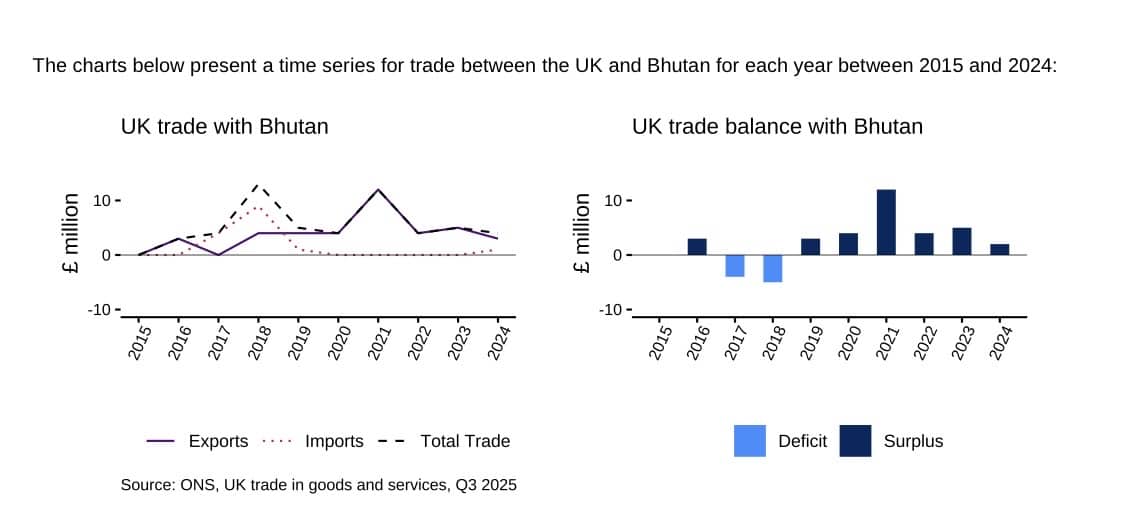
Total trade in goods and services reached £6m in the 12 months to September 2025, a 50% increase compared with the previous year. The rise was driven almost entirely by stronger British exports.
Exports from Britain to Bhutan doubled to £6m over the period. Goods accounted for about £2m, while services made up the remaining £4m, reflecting the growing importance of professional and technical services in cross-border commerce.
Among the goods Britain sells to Bhutan are beverages and tobacco products, scientific instruments, chemicals, electrical equipment and optical goods—items typically used in laboratories, technical industries or specialised services.
Imports moving in the opposite direction are far smaller. British purchases from Bhutan were less than £1m, declining slightly from the previous year. The main products exported by Bhutan to the UK included coffee, tea, cocoa products and other niche food items.
The result is a consistent trade imbalance: Britain sells far more to Bhutan than it buys.
Over the reporting period the United Kingdom recorded a trade surplus of roughly £6m with Bhutan. In the broader scheme of global commerce this is negligible, but it underscores the asymmetry of the bilateral relationship.
Indeed, Bhutan ranks among Britain’s smallest trading partners. In the four quarters to September 2025, the Himalayan kingdom was the joint 212th largest partner in Britain’s global trade network.
Overall trade between the two countries accounts for less than 0.1% of Britain’s worldwide trade flows.
Yet the numbers tell only part of the story. Economic ties between the two countries extend beyond the narrow statistics of exports and imports.
Investment flows, educational links and development cooperation have historically shaped relations between Bhutan and the United Kingdom. British institutions have played roles in areas such as finance, education and environmental conservation, while Bhutanese students and professionals continue to study and train in Britain.
Still, if trade is to catch up with investment, Bhutan will need to broaden the range and scale of products it sells abroad.
At present the country’s export profile remains narrow. Hydropower exports—primarily sold to India—dominate Bhutan’s external earnings, leaving relatively few goods destined for more distant markets such as Britain.
To expand trade with partners like the UK, economists say Bhutan will need to develop new export sectors capable of competing internationally.
One opportunity lies in premium agricultural products. Bhutan’s reputation for pristine landscapes and organic farming practices could support exports of specialty foods—such as high-value tea, organic spices, medicinal herbs and artisanal food products—targeted at niche markets in Europe.
Another area is sustainable tourism services. While tourism itself is consumed within Bhutan, partnerships with international travel companies and digital platforms could deepen service exports linked to travel planning, cultural experiences and eco-tourism.
The country could also expand exports in creative industries and knowledge services, including digital content, design services and specialised consulting tied to Bhutan’s expertise in areas such as environmental conservation and sustainable development.
However, developing these sectors will require more than entrepreneurial ambition. Structural constraints—such as Bhutan’s small domestic market, high transport costs and landlocked geography—limit its ability to scale production and reach global markets.
Improving trade logistics will therefore be essential.
Better regional connectivity, particularly access to ports and more efficient transit routes through neighbouring countries, could reduce transport costs and make Bhutanese exports more competitive in distant markets.
Equally important is improving product standards and certification. European markets, including Britain, require strict compliance with quality, safety and sustainability standards. Bhutanese exporters will need stronger certification systems and testing facilities to meet these requirements consistently.
Trade promotion efforts also matter. Bhutanese businesses often lack the market intelligence and marketing networks needed to reach foreign buyers. Government trade agencies and embassies can play a role by helping exporters participate in international trade fairs, build brand recognition and connect with distributors abroad.
Investment policy could also support trade expansion. Encouraging foreign investors—including British firms—to establish production facilities in Bhutan could help develop export-oriented industries.
Joint ventures between Bhutanese companies and British partners might open pathways for technology transfer, supply-chain integration and access to international markets.
Meanwhile, continued improvements in the domestic business environment—from regulatory efficiency to digital infrastructure—would help attract further investment and encourage local firms to scale up production.
Bhutan’s broader economic outlook suggests there is room for such growth.
Forecasts from the International Monetary Fund suggest the country’s economy will continue expanding in the coming years. GDP growth is projected to reach 6.8% in 2025 and rise to about 7.4% in 2026, supported by hydropower development, tourism recovery and domestic investment.
In nominal terms, Bhutan’s economy is expected to grow from about $3.1bn in 2024 to roughly $3.8bn by 2026. During the same period, GDP per capita could increase from around $3,900 to $4,700, reflecting rising incomes.
If those projections hold, Bhutan’s expanding economy could create new opportunities for deeper commercial engagement with partners such as the United Kingdom.
For now, the relationship remains uneven: British investment approaches the billion-pound mark, while trade flows between the two countries barely register on global charts.
Bridging that gap will require Bhutan to cultivate new export industries, strengthen logistics and build stronger commercial networks abroad.
Should those efforts succeed, the modest trade figures of today may eventually catch up with the much larger flows of capital already linking the Himalayan kingdom to Britain.
Nidup Lhamo
From Thimphu