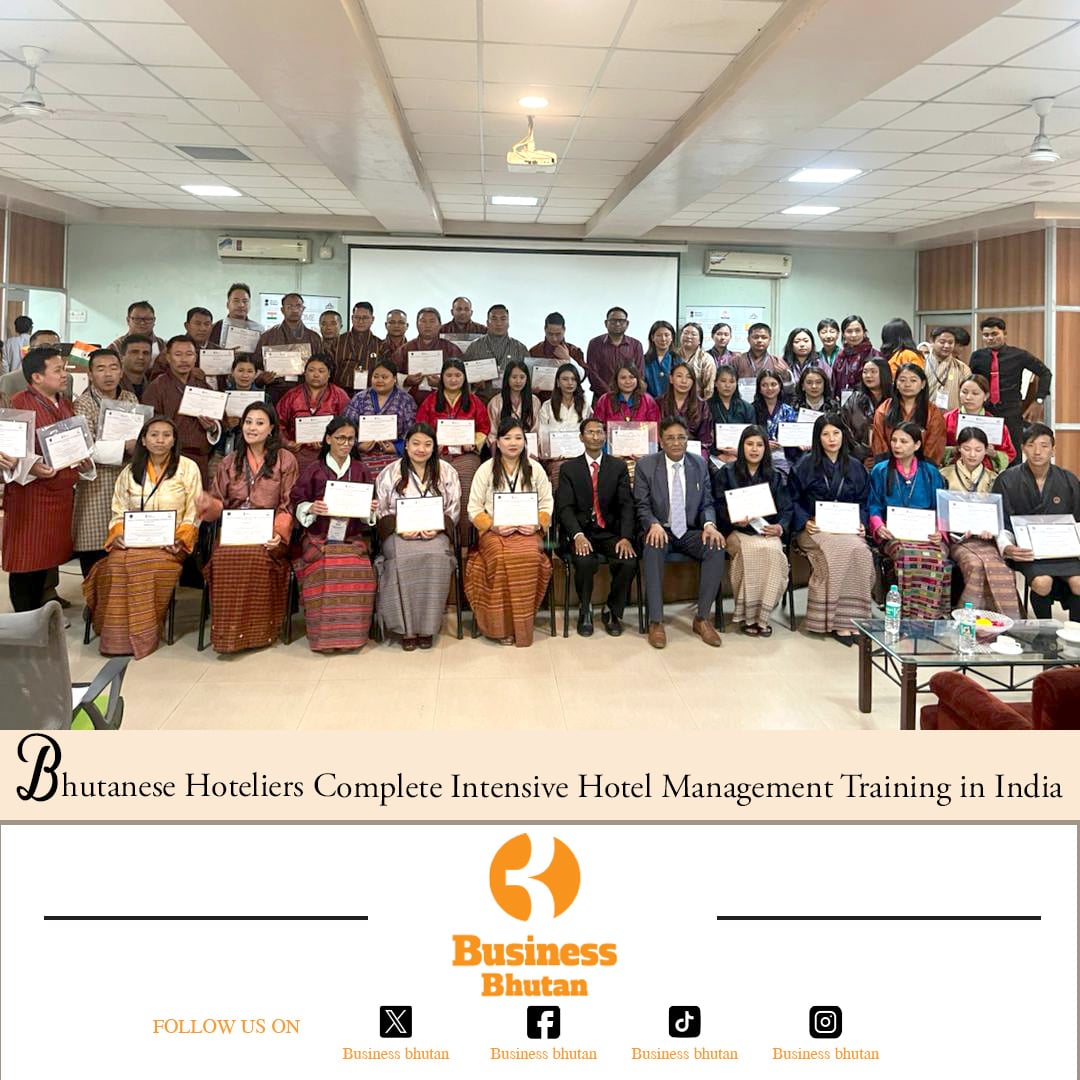
Fifty hoteliers from Bhutan have successfully completed a week-long intensive hotel management training at the Institute of Hotel Management Hajipur in Bihar, India.
The program, held from February 23 to March 1, 2026, brought together participants from 3- and 4-star member hotels of the Hotel and Restaurant Association of Bhutan (HRAB). The training aimed to strengthen the professional capacity of Bhutanese hotels and improve service standards in line with international hospitality practices.
The initiative was organised in collaboration with the Bhutan Chamber of Commerce and Industry (BCCI) and supported by the Indian Technical and Economic Cooperation Programme (ITEC).
For Bhutan’s hospitality sector, which is gradually recovering and expanding after the pandemic, the training comes at an important time as hotels seek to improve service quality, operational efficiency, and competitiveness.
Participants represented a range of established hotels from major tourist destinations including Thimphu, Paro, and Punakha. Many of these hotels serve international visitors traveling under Bhutan’s “High Value, Low Volume” tourism policy, which prioritizes sustainable tourism and high-quality visitor experiences over mass tourism.
The week-long training covered a wide range of operational and management topics essential for modern hotel operations. Sessions included hospitality best practices, front office management, housekeeping standards, reservation systems, food and beverage service, revenue management, and the use of information technology in hotel operations.
The curriculum combined classroom sessions with practical demonstrations, allowing participants to observe and practice professional hospitality techniques used in international hotels.
Radhika Timsina, the hotel manager of Bhutan Suites, Thimphu, described the training as highly practical and relevant.
“The training was very informative and beneficial. It helped us understand professional hospitality standards and provided practical knowledge that we can implement in our daily work,” she said.
Participants believe the knowledge gained will contribute directly to improving service quality in Bhutanese hotels. Skills related to guest interaction, service efficiency, and operational coordination are expected to enhance the overall guest experience, particularly for international travelers who expect professional hospitality standards.
In addition participants received training in teamwork, communication, professional grooming, guest greeting techniques, complaint handling, and customer service etiquette. Safety and emergency preparedness were also important components of the training. Participants learned about fire safety procedures, emergency response strategies, and workplace safety practices—areas that are increasingly important as hotels place greater emphasis on guest safety and risk management.
Participants highlighted that many hotels in Bhutan still operate with limited formal management systems and rely heavily on on-the-job learning.
Damcho Zam from Hotel Riverview in Punakha and Paro said that exposure to international hospitality practices is essential for the sector’s growth.
“Continuous exposure to global hospitality standards is important for Bhutanese hoteliers,” he said. “Training like this helps us understand professional systems and how to implement them effectively in our hotels.”
Similarly, Tshering Dorji, manager of Metta Resort in Paro, said ongoing professional development is critical in a rapidly evolving industry.
“The hospitality industry is constantly changing,” he said. “Training programs like this help us bridge knowledge gaps and align our operations with international standards.”
Industry observers say strengthening human resources is one of the most important steps in improving Bhutan’s tourism experience.
The training also supports Bhutan’s national tourism strategy of maintaining high-value tourism while ensuring quality experiences for visitors. Skilled hotel staff play a critical role in delivering these experiences and maintaining Bhutan’s reputation as a premium travel destination.
Participants expressed their appreciation to the BCCI and the HRAB of Bhutan for facilitating the program, as well as to the Embassy of India in Bhutan for supporting the initiative through the ITEC programme.
“Our heartfelt gratitude goes to the Embassy of India in Bhutan for their generous support in making this program possible,” participants said in a joint statement. “We also thank the trainers and staff of IHM Hajipur for their guidance and warm hospitality. The knowledge, memories, and friendships we gained will remain close to our hearts.”
Sangay Rabten
From New Delhi