

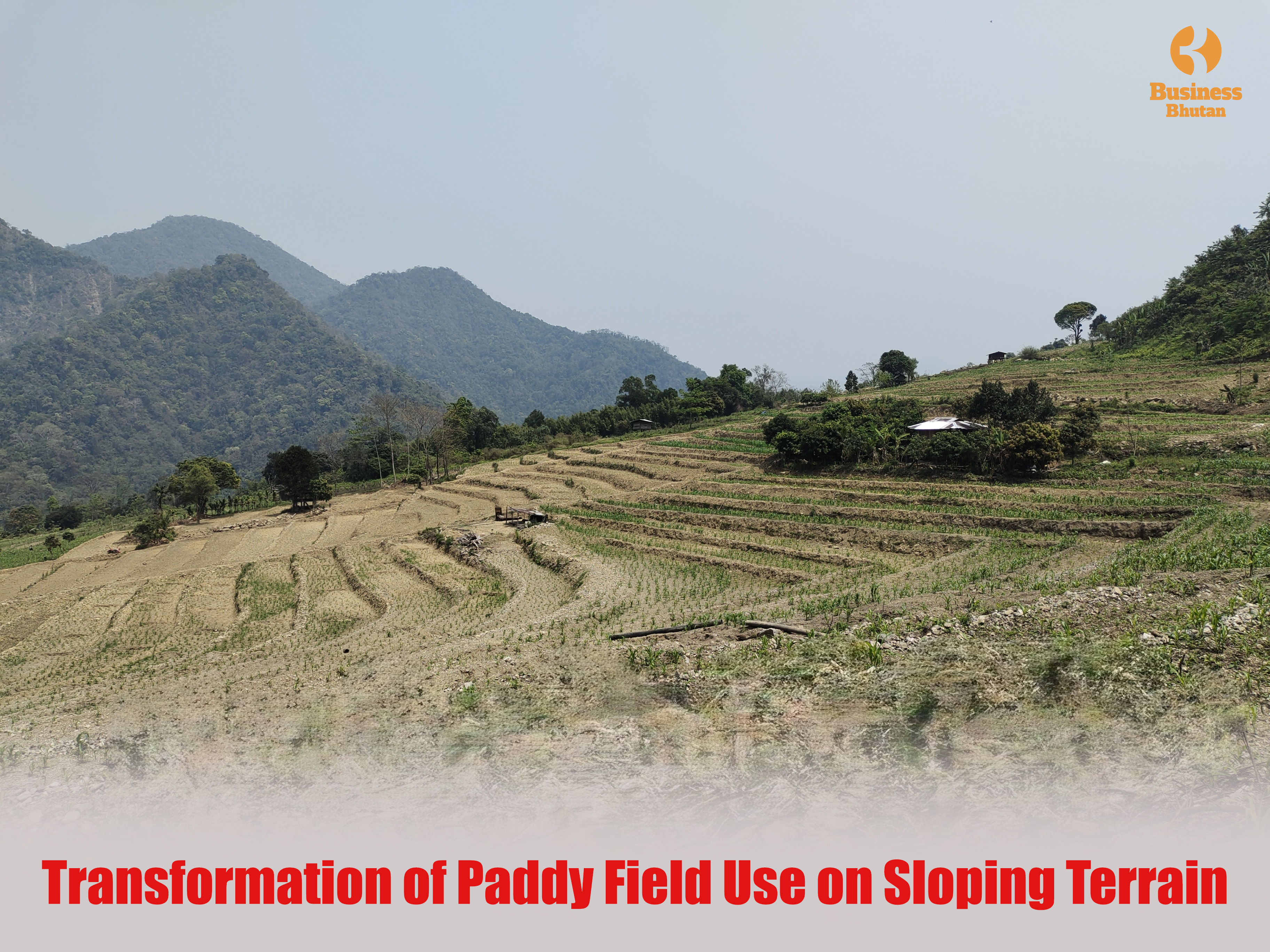
In Tikiliwoong village under Norbugang Gewog in Nganglam, Pemagatshel, farmers have begun to transform the way they cultivate paddy on challenging sloping terrain, marking a significant milestone in local rice production. Paddy cultivation remains the backbone of Bhutan’s food security and is deeply woven into its rural culture and way of life. By adopting improved land management practices, these farmers are working to secure this vital resource for future generations.
In a concerted effort to safeguard and expand their valuable paddy fields, the farming community of Tikiliwoong has strategically adopted terraced farming practices, an approach that not only maximizes the efficient use of sloping terrain but also plays a crucial role in conserving vital soil and water resources.
Through this initiative, more than 38 acres of farmland, representing the collective holdings of 31 households in Tikiliwoong, have been systematically terraced. This transformation has significantly increased the area of cultivable land, enabling farmers to boost overall productivity and better withstand the challenges of farming on steep terrain.
By implementing modern terracing techniques, the community is enhancing land stability, minimizing soil erosion, and promoting sustainable water management – all of which contribute directly to higher yields and more resilient agricultural systems. This strategic land use optimization demonstrates the community’s commitment to modernizing traditional rice cultivation while ensuring the long-term sustainability of local food production and rural livelihoods.
Khando, a 50-year-old farmer from Norbugang village, shared how this transformation has impacted his livelihood. “In the past, my paddy field was very narrow and difficult to work with,” he said. “But with support from the Commercial Agriculture and Resilient Livelihoods Enhancement Programme (CARLEP), we were able to widen the paddy fields. Now, our sloping land has been converted into wider, flatter terraces, making cultivation easier and increasing the area under cultivation.”
Encouraged by this improvement, Khando plans to scale up rice cultivation for commercial purposes, moving beyond subsistence farming. Similarly, Dhendup, 66, has expanded his small 1.5-acre paddy field to nearly four acres through the same terracing initiative. He hopes to boost production significantly, with enough surplus to sell in the market. “In the past, we barely produced enough for our own consumption. Now, with this increased area and better land management, my family can generate income from selling rice,” he explained.
Dhendup also highlighted how terracing has helped tackle soil erosion, a persistent challenge for farmers in hilly regions. “Before, heavy rainfall would wash away the topsoil, taking away valuable nutrients. The terraces slow down water flow, protect the soil, and help retain moisture – all of which means healthier crops and higher yields,” he said.
Gewog Agriculture Extension Officer, Karma, explained that the bench terracing initiative was strategically proposed under the Commercial Agriculture and Resilient Livelihoods Enhancement Programme (CARLEP) to empower farmers to convert challenging sloping farmland into productive, level terraces suitable for modern cultivation.
Recognizing the significant benefits of terracing for improving land usability, soil conservation, and sustainable water management, the project was designed with a community-led, cost-sharing model. Under this arrangement, local farmers organized and hired the necessary machinery to undertake the land cutting, while the associated expenses were jointly borne by CARLEP and the farmers themselves.
This collaborative approach not only ensured community ownership and accountability but also optimized the use of program resources to deliver maximum impact. By transforming steep, erosion-prone terrain into systematically designed bench terraces, the project has equipped farmers with a sustainable land management solution that enhances productivity, safeguards critical topsoil, and contributes to long-term food security and rural economic development.
“Bench terracing involves cutting step-like flat platforms along the slope to break the gradient,” Karma explained. “This slows down water runoff, prevents soil erosion, and makes the land more suitable for cultivation. So far, we have completed terracing on 23 acres out of the 38 acres of irrigated land in Tikiliwoong.”
However, farmers still face notable challenges, particularly the threat of wildlife destroying crops and the rising need for pesticides. The community has called for stronger support, including chain-link fencing and reliable electricity connections for their farmlands, as well as improved access to irrigation water to maximize the benefits of the terracing initiative.
The extension officer also emphasized the need for further capacity-building. “We need to provide additional support for fertilizers and train excavator operators in topsoil conservation to ensure soil health is maintained during land cutting,” Karma added.
This transformation is not limited to Tikiliwoong alone. Farmers in Yarphu Gewog, Samdrup Jongkhar, have also benefited from CARLEP’s land management program. More than 36 households there have experienced significant improvements in crop growth. Lungten, 59, from Yarphu village, said, “Our fields have been flattened, so we no longer lose topsoil during rain. It’s now much easier to plough and till the land, and the yields of our crops and vegetables have improved greatly.”
Sangay Rabten from Nganglam