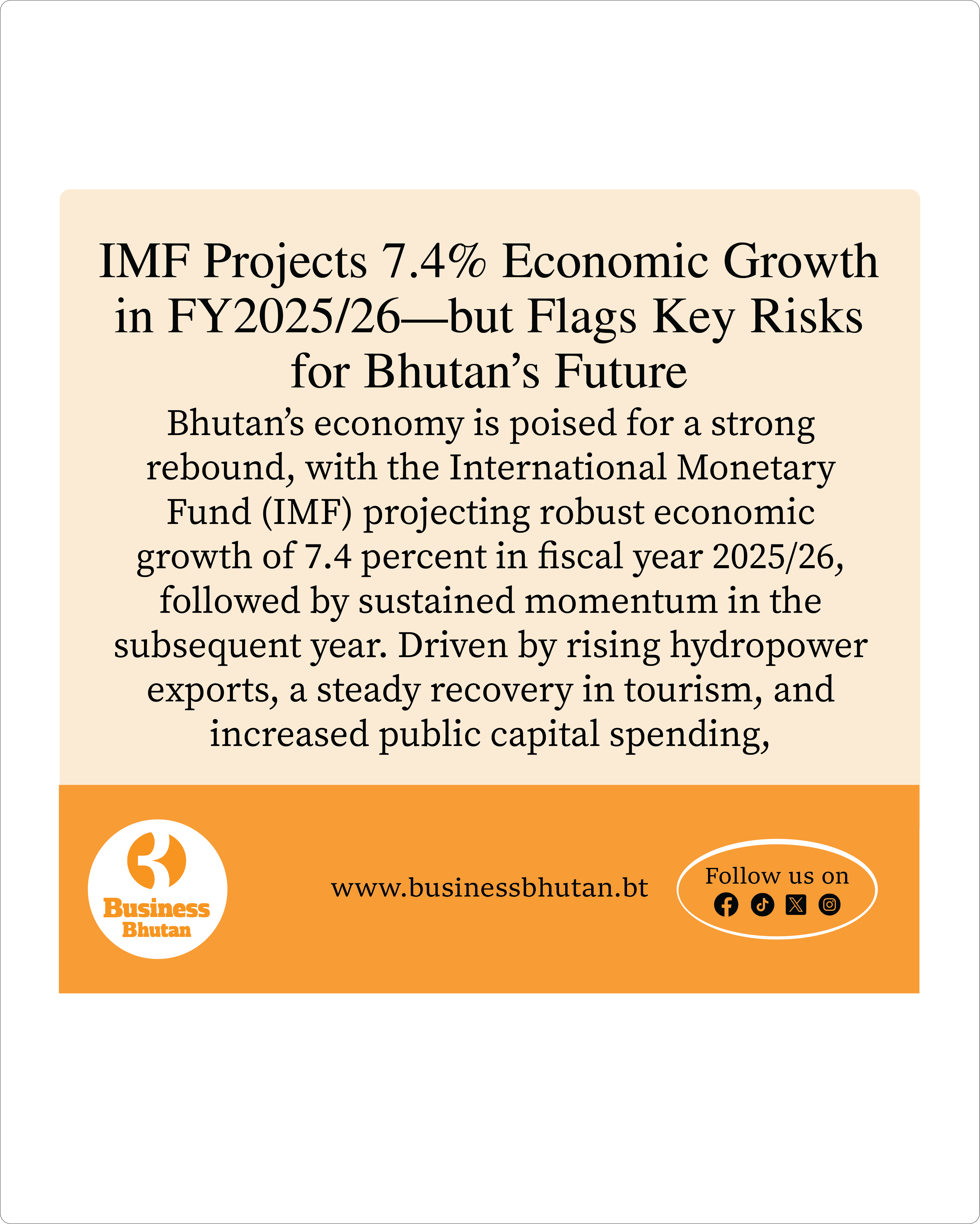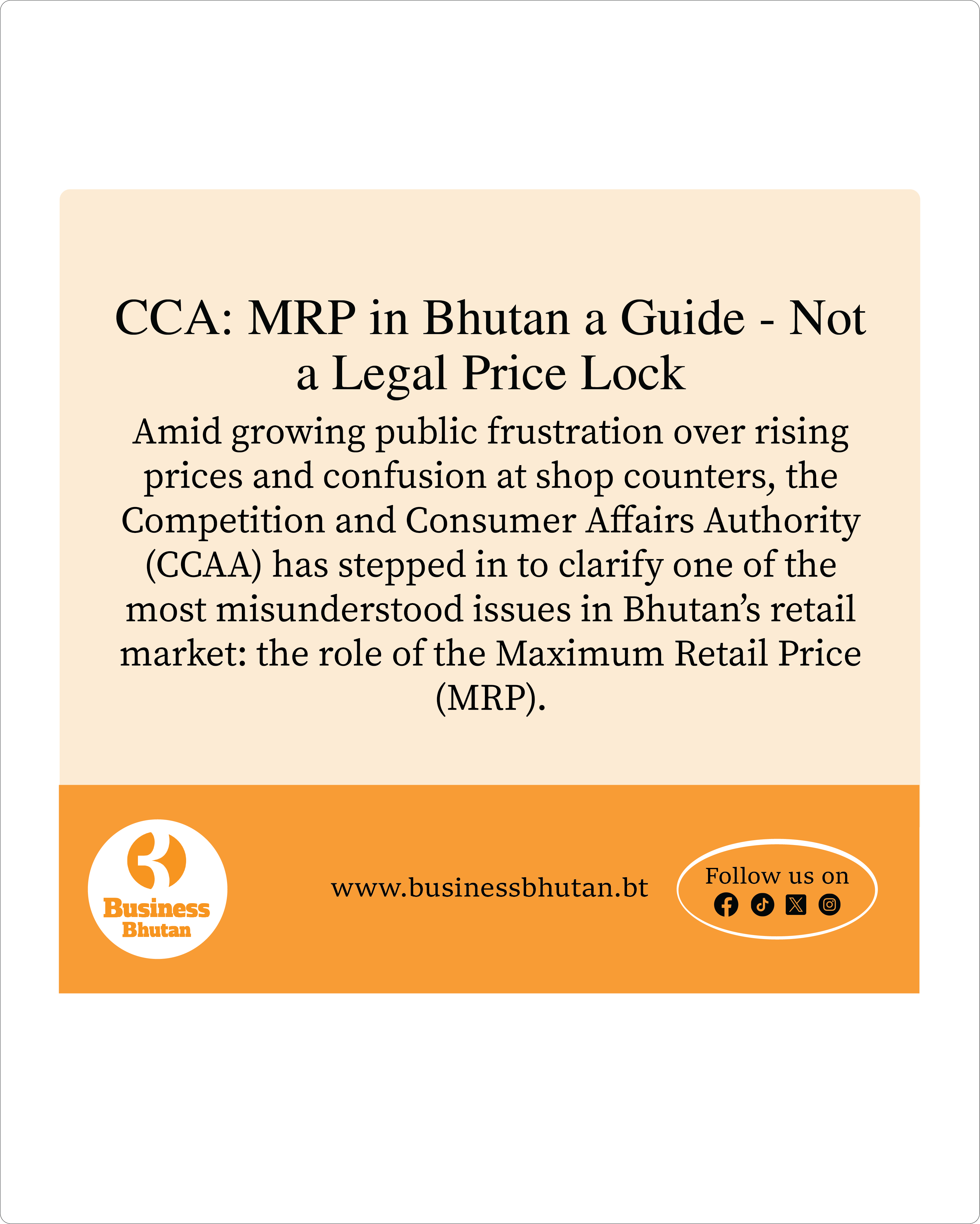


As Bhutan continues to navigate the early and often confusing days of its Goods and Services Tax (GST) regime, a new warning is emerging from tax experts and market observers: charging GST on the Maximum Retail Price (MRP) could inflate prices, distort the market, and unexpectedly push businesses into higher Business Income Tax (BIT) liabilities.
While public debate over whether GST should be applied on MRP refuses to die down—and officials reiterate that MRP cannot be practically monitored—experts caution that misapplying GST is not just a consumer issue. It could come back to haunt shopkeepers themselves, eroding profitability, triggering higher tax obligations, and undermining trust in the tax system.
At the heart of the confusion lies a simple but widely misunderstood principle: GST is already embedded in the MRP.
GST on MRP
“Shop owners cannot charge GST on the MRP,” an expert explained. “Even if they do, the total price paid by the consumer must not exceed the MRP.” But across markets, consumers report prices creeping beyond what is printed on packets—often justified by shopkeepers as “GST charges.” According to experts, this practice is fundamentally flawed.
To illustrate, the expert cited a common example. “If a shopkeeper sells an orange juice with an MRP of Nu 15 and then charges GST on top of that, it is incorrect,” he said. “The actual cost of that juice at the production stage may be around Nu 5. Even after adding transport, wholesale margins, and retail margins, the final price—including GST—is designed to stay within the MRP.”
The Supply Chain Reality
Experts emphasize that GST is a multi-stage tax, collected incrementally across the supply chain. Each stage adds value, charges GST on that value, and passes it forward. By the time a product reaches the retailer, the tax burden has already been absorbed into the final price.
“The system is designed so that the retail price remains within the MRP,” the expert said. “Retailers still make profits because they purchase goods at prices below the MRP. That margin is their earnings—not an excuse to add GST again.”
Retailers who understand this, he added, quietly price goods below MRP, comply with GST rules, and remain profitable—without provoking consumer anger or regulatory scrutiny.
GS’ Becomes a Cover for Overpricing
One of the most alarming trends flagged by experts is the misuse of GST as a justification for steep price hikes. “There are cases where shopkeepers are effectively charging 100 percent tax and calling it GST,” the expert warned. “A product that used to sell for Nu 5 is suddenly priced at Nu 10. That is not a 5 percent GST—that is a 100 percent increase.”
Such practices, he said, often stem from misunderstanding rather than malice. Many small retailers lack proper training in how GST works and struggle to adjust prices correctly.
“Market forces will ultimately decide,” the expert said. “How long can shopkeepers keep charging excessively high prices? Consumers will stop buying. That’s not a business model—it’s a short-term gamble.”
The Market Will Push Back
GST, experts stress, is meant to be a neutral tax—one that does not distort prices or create artificial advantages. “If one shop sells a packet of Maggi for Nu 10 and another sells it for Nu 5, consumers will go to the cheaper shop,” the expert explained. “That’s how competition protects consumers.”
Unless the source price of goods rises—due to transport costs, supply shortages, or import price hikes—GST alone should not create dramatic price differences between shops. When it does, it signals either inefficiency or overcharging.
“This neutrality is the strength of GST,” he said. “It prevents arbitrary pricing and rewards efficiency.”
The Hidden Trap
While consumers feel the immediate pain of inflated prices, experts warn that retailers themselves may be walking into a tax trap.
“When a shopkeeper sells a product at an MRP of Nu 200 and then adds 5 percent GST, the customer pays Nu 210,” the expert explained. “But for tax purposes, the shopkeeper’s turnover is still considered Nu 200.”
This inflated turnover, he said, can have serious implications for Business Income Tax (BIT).“Many shopkeepers don’t realize this, but by charging GST incorrectly on MRP, they may push their declared turnover beyond the BIT threshold,” he said. “That means higher tax liabilities—sometimes without any real increase in profit.”
Simplicity Is the Safest Path
Experts argue that the solution lies not in complex pricing strategies, but in simplicity and adherence to fundamentals.
“Keep it normal,” the expert advised. “Sell below MRP, apply GST correctly within the price, and declare honestly. Complicating things under the guise of GST only creates confusion and risk.”
He noted that Bhutan’s GST system, being multi-stage, is actually designed to reduce evasion. If tax is avoided at one stage, it is likely to surface at another. “That’s why evasion and avoidance are harder under GST,” he said. “The reforms are meant to close gaps, not create new ones.”
Digital Invoicing: The Game Changer
Looking ahead, experts say the real enforcement power of GST will come not from inspections, but from digital invoicing. “The future of GST enforcement lies in digital systems,” the expert said. “Once sales data is stored in secure servers and cloud platforms, it becomes extremely difficult to manipulate prices or evade taxes.”
With digital invoices, authorities can track transactions across the supply chain, cross-check declarations, and identify anomalies—bringing clarity to a system currently clouded by confusion.
“This transparency will protect consumers, honest businesses, and the government,” he added. “It will also help resolve the misunderstandings we are seeing today.”
A Painful Transition—but a Necessary One
Experts acknowledge that the transition to GST has not been easy. For small retailers, especially those without accounting support, the learning curve is steep. Mistakes are inevitable.
But they insist the long-term benefits outweigh the short-term discomfort.
Sherab Dorji
From Thimphu