

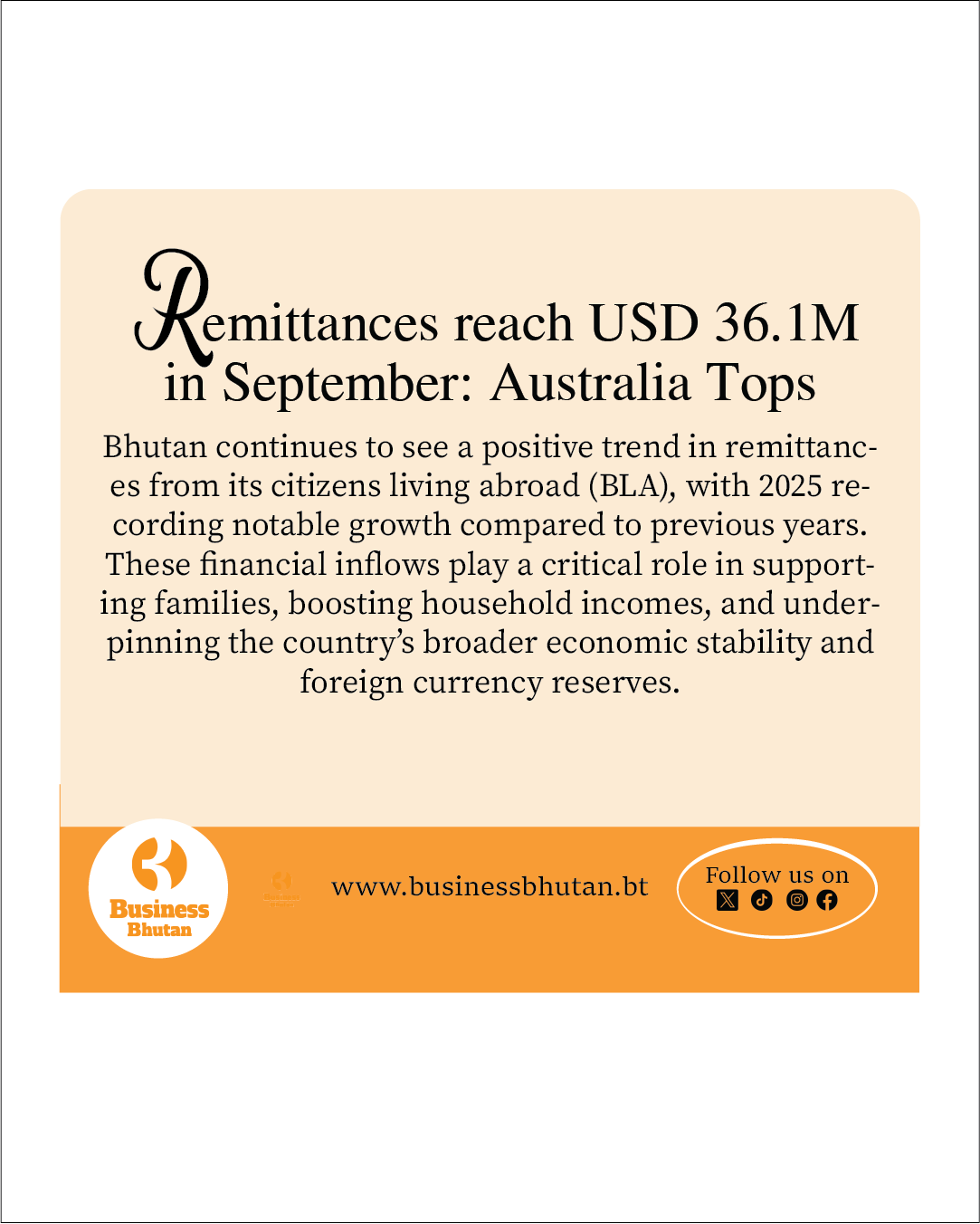
Bhutan continues to see a positive trend in remittances from its citizens living abroad (BLA), with 2025 recording notable growth compared to previous years. These financial inflows play a critical role in supporting families, boosting household incomes, and underpinning the country’s broader economic stability and foreign currency reserves.
According to the Central Bank of Bhutan’s November statistical bulletin, Australia remains the top source of remittances for Bhutanese workers. In September 2025, remittances from Australia reached USD 29.1 million, an increase of nearly USD 11 million compared to the same month in 2024.
Throughout the first nine months of 2025, remittance flows from Australia followed an upward trajectory, rising from USD 11.8 million in January to a peak of USD 22.9 million in May. While there was a modest dip in July and August to USD 20.7 million and USD 19.8 million respectively, these figures remain substantially higher than the previous year, reflecting the robust earning potential of Bhutanese workers in Australia, particularly in healthcare, hospitality, and agriculture sectors.
The United States continues to be a stable contributor, with monthly remittances rising gradually from USD 1.7 million in January and February to USD 2.3 million in September. Although the growth is steady rather than dramatic, it underscores the reliability of employment opportunities for Bhutanese workers in the US and their consistent support to families back home.
Canada has also emerged as a notable contributor, with September remittances doubling to USD 1.2 million from USD 0.6 million in the same month of 2024. Other countries, including Kuwait and the United Kingdom, have recorded steady increases, while Qatar, UAE, Hong Kong, Singapore, and New Zealand continue to provide modest but consistent flows.
Collectively, these diverse remittance sources underscore the increasing economic importance of Bhutanese migrant workers, whose earnings provide critical support to households, stimulate local economies, and strengthen national financial stability. Beyond directly benefiting families, these inflows help maintain foreign currency reserves, facilitate essential imports, and contribute to the country’s overall macroeconomic resilience. In essence, Bhutanese workers abroad not only sustain their communities at home but also act as a vital economic lifeline, reinforcing the nation’s development and stability in an increasingly interconnected global economy.
While Australia accounts for the largest total remittance volume, this does not necessarily mean it represents the highest per capita remittance. Analysts note that the high aggregate figures largely reflect the large number of Bhutanese workers residing in Australia, rather than exceptionally high individual transfers.
The central bank attributes the overall increase in foreign currency reserves to a combination of robust inflows from hydropower exports, international loans and grants, and remittances. It confirmed that current reserve levels are sufficient to meet the constitutional requirement of covering at least one year’s worth of essential imports, in line with Article 14, Section 7 of the Constitution.
To make remittances accessible and secure, Bhutan offers nine official channels. Bhutan Post has the Western Union and EuroGiro and T-Bank, its T-Pay Remit and Prabhu Money Transfer. Bhutan National Bank has MoneyGram and Ria Money Transfer and Bank of Bhutan the Ria Money Transfer and BoBit. Bank Transfers are done via SWIFT
These channels ensure that remittances continue to be a major source of convertible foreign currency, helping families meet household needs and sustaining national economic resilience.
Meanwhile, Bhutan continues to experience a positive trend in remittances from its citizens living abroad (BLA), with 2025 showing notable growth compared to previous years. These financial inflows are far more than simple transfers of money; they directly support families, help raise household incomes, and improve the quality of life for communities across the country. Beyond household-level benefits, remittances play a strategic role in Bhutan’s national economy, bolstering foreign currency reserves, facilitating essential imports, and strengthening macroeconomic stability. In a small, developing economy like Bhutan’s, where domestic revenue streams can be limited, these inflows act as a buffer against economic shocks, ensure continued financial liquidity, and enable the country to plan and invest in long-term development initiatives. Essentially, remittances are a vital economic lifeline, sustaining both livelihoods and national prosperity.
Sherab Dorji
From Thimphu