

A key amendment in the Livestock Bill of Bhutan 2025 has sparked widespread public debate, with many assuming it authorizes the establishment of slaughterhouses. However, lawmakers and the Environment and Climate Change Committee (ECCC) members clarified in the National Assembly (NA) this week that the provision—an added subsection after Section 10(2)—is intended solely to regulate, not encourage, animal slaughter or the creation of new abattoirs.
Committee members explained that the subsection empowers the Ministry of Agriculture and Livestock (MoAL) to categorize livestock processing facilities and issue technical clearances based on hygiene and safety standards. These processing facilities range widely across the livestock sector and are not limited to slaughter units. They include dairy plants, cheese and butter facilities, feed processing units, egg grading centres, meat drying units, and other value-addition enterprises.
“Unfortunately, viewers watching the live deliberations may be easily carried away by selective interpretations or misinformation and as we all know false talk often becomes the king of talk,” stated a committee member.
“The main debate in the parliament centered on the new section inserted after 10(2) by the committee. The narrative created during the deliberation that the government is going to establish a slaughterhouse has been widely misunderstood,” the member said.
He added that the provision simply authorizes the ministry to categorize processing facilities and issue technical clearances based on hygiene and safety standards. “Nowhere does it permit the establishment of a slaughterhouse,” he reminded.
The new subsection after section 10(2) stated: “Categorize processing facility and issue technical clearance to only those that meet the required standards as prescribed in the rules and regulations.”
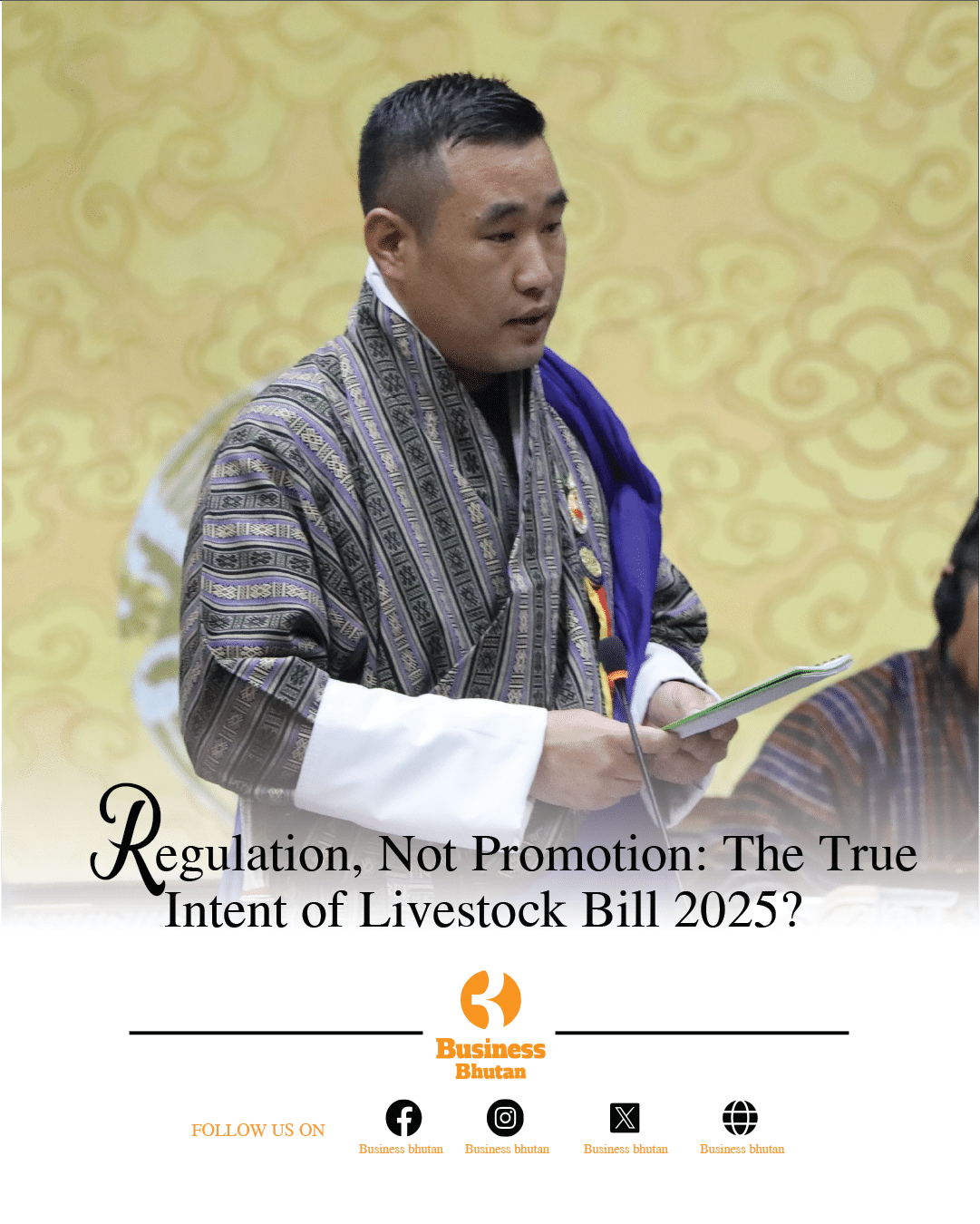
“This is simply about standard-setting and issuing clearances based on prescribed rules. These sections do not establish a slaughterhouse; they ensure legal, hygienic, controlled and compassionate practices,” said Lamgong-Wangchang MP Sonam Tashi, “I explicitly reiterated that the Livestock Bill of Bhutan 2025 is primarily about animal welfare. The Bill focuses on better standards, safer facilities and improved care for animals. Some provisions have been misunderstood, but its intent is clear: to strengthen animal wellbeing and safety in the livestock sector,” the MP further added.
The ECCC noted that similar provisions already existed under the Livestock Act of Bhutan 2001, and that the intent remains unchanged: ensuring public health, food safety, and humane treatment of animals. Members cautioned that refusing to regulate such activities could mirror the unintended consequences of the former Tobacco Act, where strict prohibitions only pushed the practice underground.
Intense Debate in the House
During the Bill’s third reading, MPs offered sharply differing views shaped by religion, economics, public health, and consumer habits.
Thrimshing–Kangpara MP Damche Tenzin questioned the moral implications of the provision. “In the past it was called ‘slaughter’ and now it is ‘abattoir’, but it carries the same meaning. What is the main motive? We need clarity.”
Several members argued that Bhutan’s strong religious values should guide policy, urging the country to avoid slaughtering animals altogether.
However, others stressed that regulations must reflect current realities. Health Minister Tandin Wangchuk said the approach should focus on reducing consumption rather than imposing absolute bans.
“No matter how religious we are, slaughtering will continue as long as there are consumers. Instead of saying we cannot establish slaughterhouses; we should encourage people to reduce meat consumption. Regulations are essential.”
Committee and Ministers Clarify Intent
The ECCC pointed out that the debated subsection is not a new motion, but a condensed version of earlier legislative provisions.
“This is not a new clause. Even within the committee, opinions differed, which is why we leave the final decision to the House,” committee chairperson Tashi Tenzin said.
The Finance Minister expressed strong support, arguing that regulated facilities could strengthen food safety, reduce import dependency, and positively impact the national economy.
Other MPs urged colleagues to approach the provision with pragmatism rather than emotion.
MP Sonam Tashi highlighted the need to acknowledge actual consumer behavior. “Around 88.9 percent of Bhutanese consume meat. We cannot tell people not to consume it. The Bill does not promote slaughterhouses—it creates opportunities for livelihood under proper regulations,” he added.
“Guided by the provisions of the Constitution of Bhutan, I supported the Bill because it is fundamentally about regulation, animal welfare and ensuring proper standards. Its intent is to modernize existing provisions, strengthen oversight and protect both public health and the humane treatment of animals. I encourage interested individuals to go through the Bill for clarity and understanding as it moves to the next stage of deliberation.”
Agriculture and Livestock Minister Younten Phuntsho added that public concerns raised during consultations in ten dzongkhags must be addressed, but noted that the ministry sees no major issues with the existing provisions.
Despite the heated debate, the central message from the government remains consistent: the Bill aims to regulate livestock-based activities, ensure food safety, and uphold animal welfare—not to encourage the establishment of slaughterhouses.
The Livestock Bill of Bhutan 2025 was passed by the NA on Wednesday and will be deliberated in the National Council (NC) during the Summer Session of 2026. The Bill was first tabled in the 3rd Session of the 4th Parliament by the Agriculture and Livestock Minister as a Government Bill and was referred to the ECCC for detailed review.
Some changes made to the Bill in the NA include “Prohibiting the operation of processing facility and import or sale of meat on the auspicious days of 8th, 10th, 15th, 25th and 30th; on 4th day of the 6th month; on the descending day of Lord Buddha; Zhabdrung Kuchoe; and, on the 1st and 4th month of the Bhutanese calendar.”
Tashi Namgyal
From Thimphu