

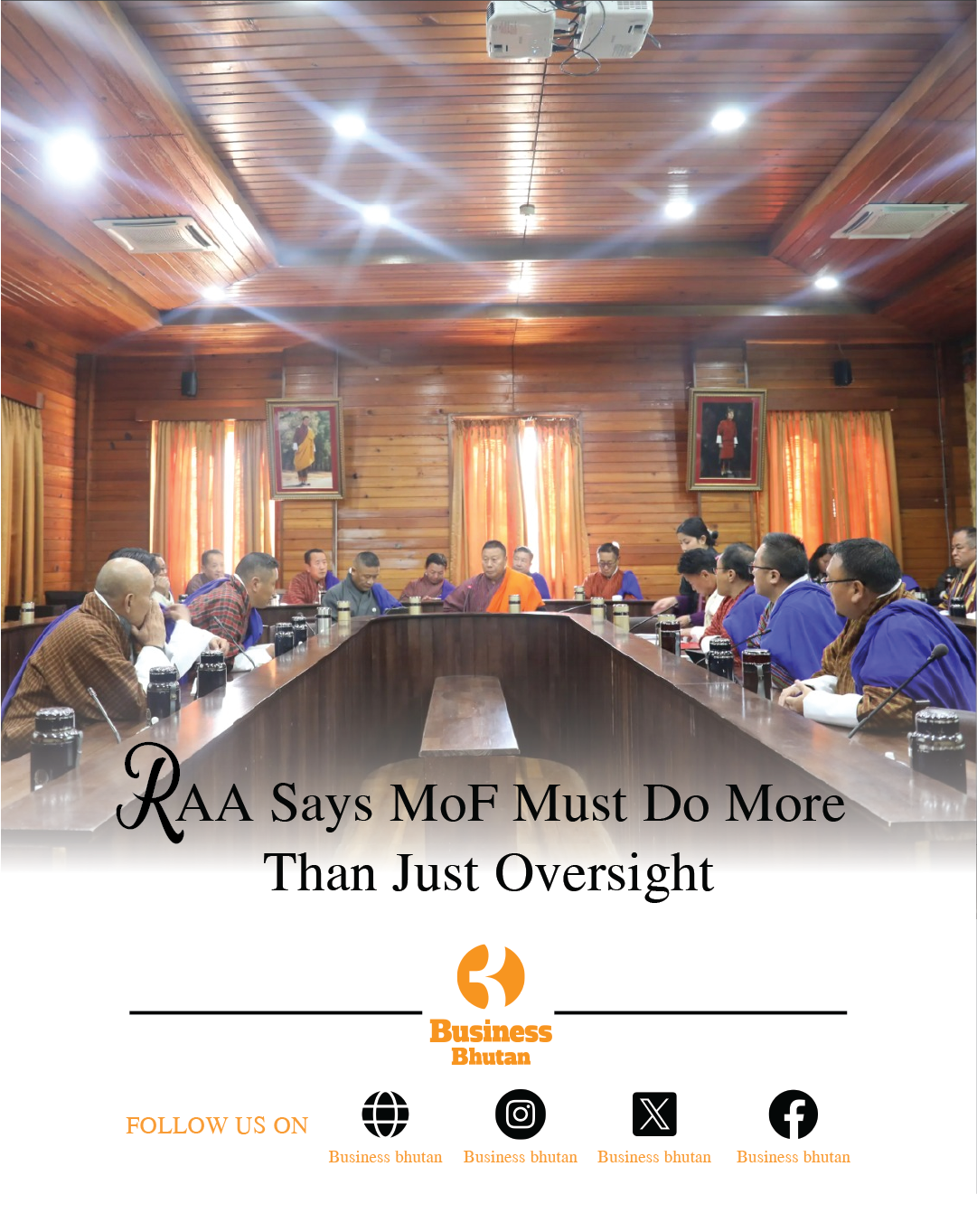
The Royal Audit Authority (RAA) has said the Ministry of Finance (MoF) needs to move beyond general “oversight” and take a more hands-on role in enforcing financial rules, monitoring compliance and ensuring that public money is properly protected.
In its latest audit observations, the RAA pointed to repeated weaknesses in procurement enforcement, asset management, salary administration and the recovery of government dues—issues that continue to surface year after year despite existing rules and systems.
“Oversight alone is not enough if rules are not being enforced consistently,” one RAA official said. “What we are seeing are repeat issues that require stronger monitoring and timely corrective action.”
A major concern raised by the RAA relates to the enforcement of the Procurement Rules and Regulations (PRR) 2023, particularly in cases where contracts are terminated due to fundamental breaches.
The audit found that many agencies recover either liquidated damages or 20 percent of the value of incomplete works—but not both. Under the PRR, however, agencies are required to recover both, as they serve different purposes.
“Liquidated damages are meant to compensate for delays, while the 20 percent recovery reflects the additional cost of completing unfinished works,” the RAA clarified. “The rules are clear, but they are not being fully applied.”
The Authority also noted that some agencies hesitate to terminate contracts even after liquidated damages exceed the 10 percent ceiling, citing the cost and time involved in re-awarding works. The RAA warned that this weakens accountability and allows delays to continue without meaningful consequences for contractors.
In hydropower projects, the RAA observed long delays in recovering excess payments and financial adjustments from contractors. In many cases, recoveries were made without applying interest, resulting in opportunity costs and added loan burdens.
“When recoveries are delayed and interest is not applied, the financial cost is ultimately borne by the project and the public,” one RAA official said.
The Authority recommended that the MoF mandate interest clauses in future contracts—especially for large, capital-intensive projects—to ensure timely recoveries and safeguard public resources.
The RAA also flagged slow and inconsistent use of the Government Inventory Management System (GIMS), calling it a missed opportunity for better asset tracking and transparency.
Despite being launched in 2021, the system remains poorly adopted, with 171 GIMS-related cases across 81 agencies. The audit attributed this to technical issues and a lack of enforced compliance.
“A system alone does not ensure accountability,” the RAA noted. “There must be enforcement, user support and consequences for non-compliance.”
The Authority recommended a full system review, mandatory usage linked to performance management, and continuous capacity-building for users.
The audit identified 120 cases of incorrect and inadmissible salary and allowance payments, amounting to Nu 11.611 million (M) across 64 agencies. These errors were linked to weak coordination between HR and Accounts sections.
“Delayed detection creates problems for both the government and employees,” the RAA said. “Overpayments have to be refunded, and underpayments deprive individuals of what they are rightfully owed.”
The Authority urged the MoF and the Royal Civil Service Commission (RCSC) to strengthen system integration between e-PEMS and ZEST, with additional verification layers.
The RAA raised concerns over the misuse of Closed Work Accounts, where agencies booked expenditures for works that had not started or were incomplete—often to avoid budget lapses. Such practices, the audit noted, misstate financial records and violate financial manuals.
Persistent delays in settling deposit works were also flagged, with advances remaining unadjusted across multiple fiscal years.
“These are not isolated cases,” the RAA warned. “They point to weaknesses in budget monitoring throughout the financial cycle.”
The audit reported 40 cases of non-collection of rebates worth Nu 9.497M on cement and HDPE pipe procurement, despite MoF notifications decentralizing rebate collection.
To simplify the process, the RAA suggested exploring pricing mechanisms that deduct rebates upfront at the point of sale for departmental works.
“This would reduce administrative burden while improving compliance,” the Authority noted.
In a broader observation, the RAA highlighted the link between ethical behaviour and fair compensation in the civil service. It cautioned that low remuneration, combined with restrictions on external income, could create financial pressure that contributes to unethical practices.
“Fair compensation should be seen as an investment in integrity, not a cost,” the RAA stated.
While acknowledging progress in systems such as FinDoc, the RAA stressed that real improvement will depend on how actively the MoF enforces rules, follows up on audit findings and holds agencies accountable.
“Rules already exist,” an RAA official said. “What is needed now is consistent enforcement, timely follow-up and stronger ownership at the centre.”
The message, the RAA said, is clear: better systems must be matched by stronger action to protect public money and improve financial discipline.
Tashi Namgyal
From Thimphu