

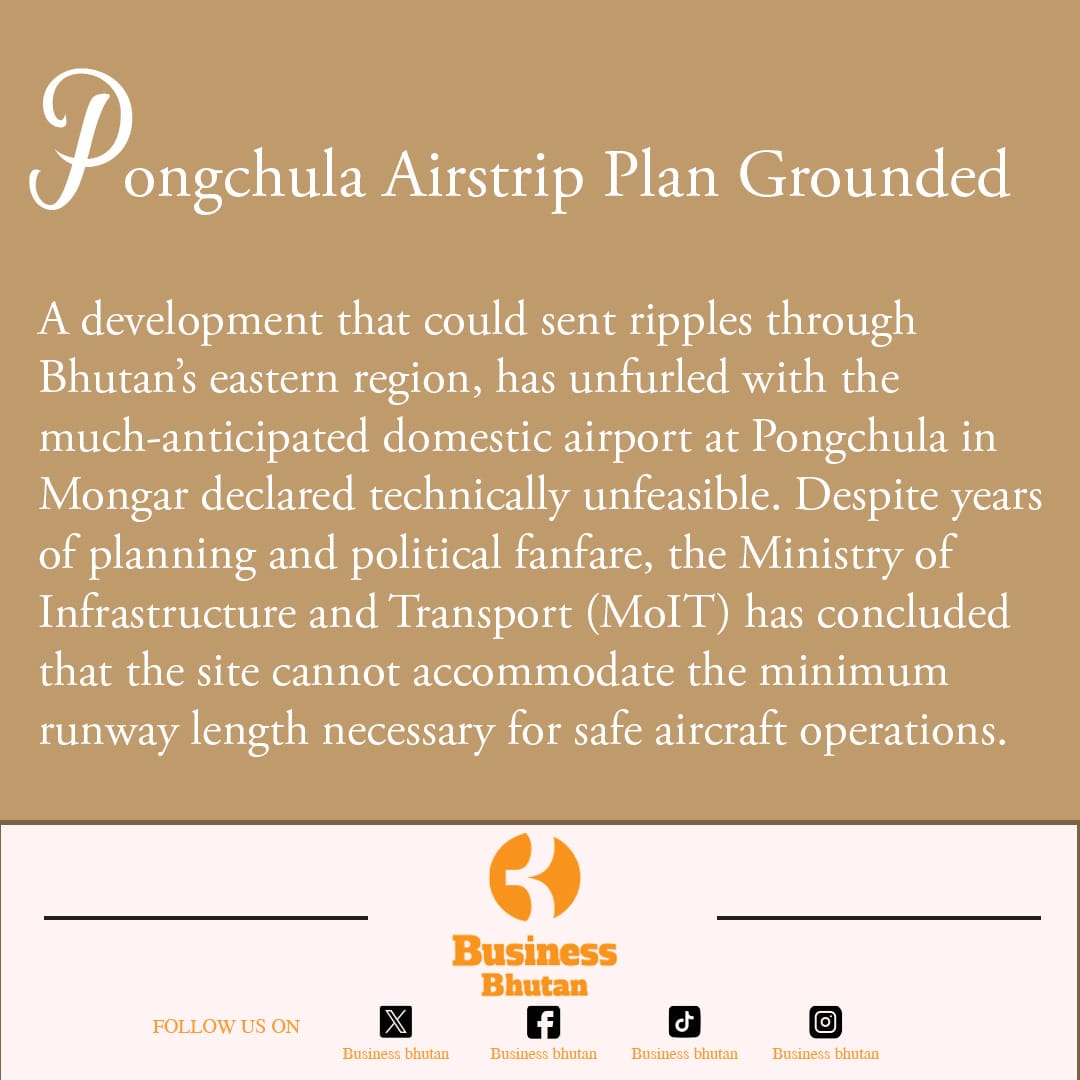
A development that could sent ripples through Bhutan’s eastern region, has unfurled with the much-anticipated domestic airport at Pongchula in Mongar declared technically unfeasible. Despite years of planning and political fanfare, the Ministry of Infrastructure and Transport (MoIT) has concluded that the site cannot accommodate the minimum runway length necessary for safe aircraft operations.
The Ministry’s latest reassessment has definitively ruled out Pongchula after meticulous technical studies revealed that the ridge simply cannot support a runway long enough for even the smallest aircraft currently operating in Bhutan. “Even after considering modifications to the ridge, the maximum achievable runway length is around 1,000 metres, which falls short of aviation safety standards,” officials said. By comparison, aircraft such as the ATR 42-600 and the PC-24 require runways between 1,200 and 1,700 metres to operate safely. The verdict is clear: Pongchula cannot become the eastern aviation hub many had envisioned.
For residents of Mongar and surrounding districts, this news is understandably a disappointment. The Pongchula airport first emerged on Bhutan’s aviation radar in 2018, hailed as a beacon of progress that would dramatically improve air connectivity in the east. Politicians highlighted the proposal in election campaigns, promising that the airport would unlock opportunities, attract investment, and make travel faster and safer. The dream of a bustling airstrip on the Pongchula ridge, however, has now been grounded—literally.
Meanwhile, the setback also offers a critical reminder of why domestic airports matter so profoundly. Bhutan’s challenging terrain, with its steep ridges, deep valleys, and winding roadways, makes air travel more than just a convenience—it is a crucial enabler of mobility and development. Domestic airports connect remote regions to the capital, allow for rapid transport of goods, and provide timely access to emergency services. Without safe and reliable airstrips, the country risks leaving its far-flung communities isolated.
The Ministry of Infrastructure and Transport has been quick to emphasize that the Pongchula ruling does not signal a slowdown in Bhutan’s broader aviation ambitions. Domestic airport development remains a cornerstone of the government’s strategy to enhance regional connectivity, foster economic growth, and ensure balanced national development. “While some proposed sites may be ruled out due to technical limitations, we continue to pursue other viable locations,” the ministry confirmed.
Indeed, work is already advancing on promising alternatives. Potential airports in Yoeseltse and Samrang are undergoing detailed assessments, including rigorous geotechnical studies conducted with technical support from the Bhutan Standards Bureau. These studies, completed in September 2025, evaluated ground stability, soil conditions, and other crucial geological factors to ensure that future infrastructure will be safe, sustainable, and resilient. Complementing these efforts, topographical surveys in August 2025 with the National Land Commission provided precise data on terrain elevation, land features, and spatial layout—vital for the meticulous planning required for airfield construction.
The Department of Air Transport has now prepared draft detailed designs and preliminary cost estimates for Yoeseltse and Samrang, signaling that Bhutan’s domestic aviation network is far from grounded. A comprehensive report on these projects will soon be submitted to the government, paving the way for potential construction and bringing the promise of regional airports closer to reality.
The importance of domestic airports cannot be overstated. Beyond the obvious convenience of reducing travel time, these airstrips serve as catalysts for economic activity, tourism, and trade. They allow farmers and small businesses in remote districts to access larger markets efficiently. They enable rapid deployment of medical supplies, disaster relief, and essential services, especially in emergencies where mountainous terrain can make road travel slow or impossible. In short, domestic airports are lifelines that link Bhutan’s dispersed communities to the broader national and international economy.
Pongchula’s technical infeasibility also highlights a critical lesson for infrastructure planning in Bhutan: careful, science-based assessments are essential before any construction begins. The decision reflects the government’s commitment to safety, sustainability, and fiscal responsibility. Building an airport where the terrain cannot safely support aircraft would have been a costly mistake with potentially severe consequences. By ruling out Pongchula now, Bhutan avoids such risks and refocuses resources on sites with genuine potential.
For residents of Mongar, the setback may be disappointing, but the larger vision remains intact. Domestic airports are not a luxury—they are an indispensable part of Bhutan’s national development agenda. By connecting remote communities, fostering trade, enhancing tourism, and supporting emergency services, these airports ensure that no part of the country is left behind.
While Pongchula will remain a ridge unmarked by runways, the momentum behind Bhutan’s domestic aviation expansion continues unabated. Yoeseltse and Samrang could well become the next hubs that transform regional connectivity, proving that setbacks are merely stepping stones on the path to progress.
Nidup Lhamo
From Thimphu