

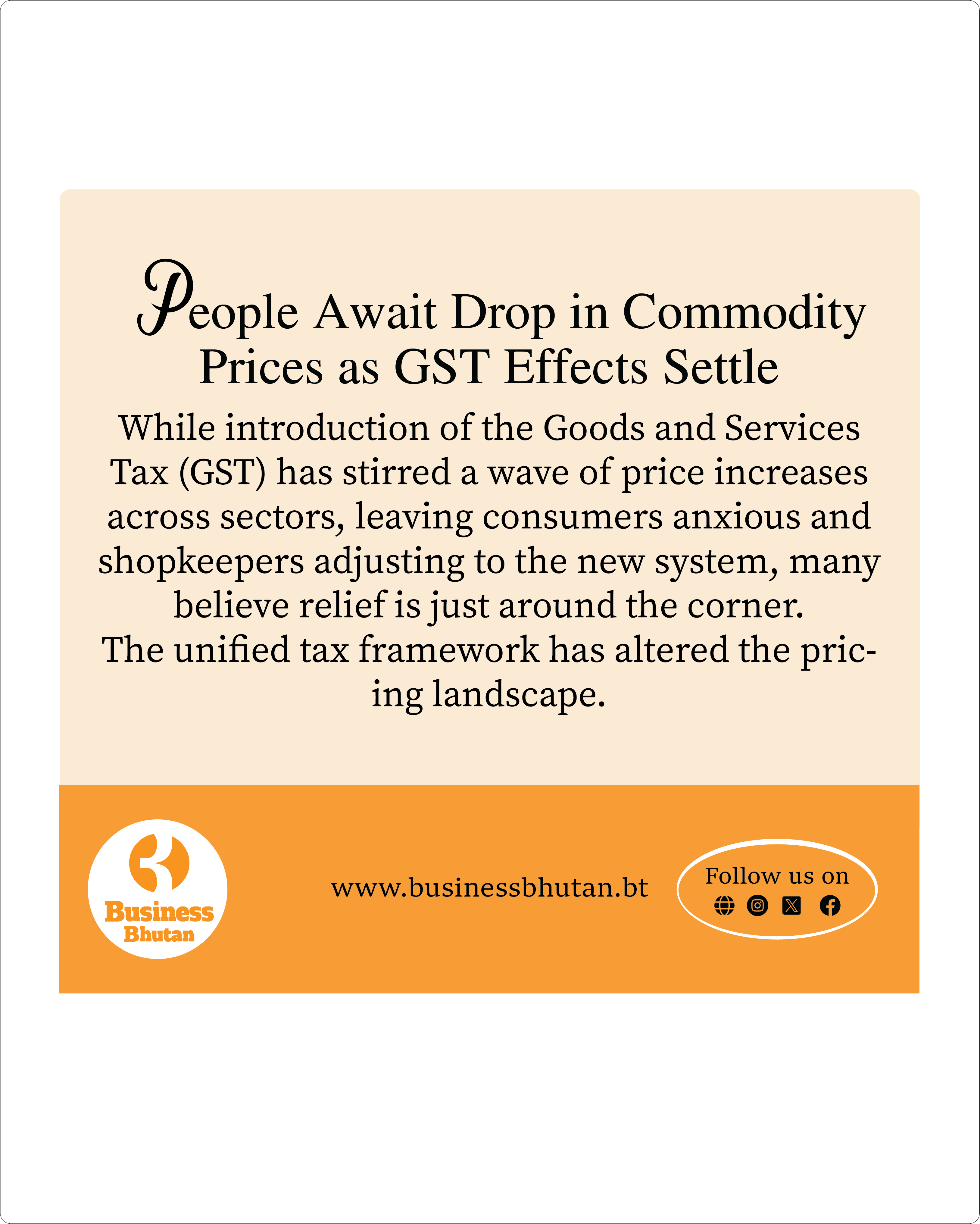
While introduction of the Goods and Services Tax (GST) has stirred a wave of price increases across sectors, leaving consumers anxious and shopkeepers adjusting to the new system, many believe relief is just around the corner.
The unified tax framework has altered the pricing landscape. Essential items such as food grains, milk, and vegetables are either exempt from GST or taxed at minimal rates, offering some relief. But luxury goods—tobacco, carbonated drinks, high-end automobiles—are now subject to higher taxes, translating into steeper costs. Even services like restaurants, telecommunications, and online platforms have revised their rates under GST, making some everyday services slightly more expensive.
For ordinary Bhutanese, the changes are palpable. Bal Singh Biswa, a bakery owner in Samtse, noted that the prices of basic groceries had jumped since GST implementation, often exceeding the maximum retail price. Still, he remains optimistic. “The rise in prices may be due to stock accumulated during the previous tax regime. The new system is better organized, and I expect commodity prices to fall over time,” he said.
Shopkeepers themselves are adjusting. Tshewang Lhamo, a retailer in Paro, explained that many shops in Thimphu were charging GST directly on the MRP—a practice she says is flawed. “GST should be applied based on buying price plus margin, not the full MRP. With most tax slabs reduced under GST, I can now offer items at lower rates to consumers,” she said, signaling a potential easing of costs in the coming months.
Consumers are hopeful but cautious. Ugyen Wangmo, a former business owner from Phuentsholing, noted widespread confusion about GST. “Many people either haven’t received proper awareness or cannot grasp the tax changes. But mathematically, the unified 5% slab should lower prices. Items that previously carried a 10–15% Bhutan Sales Tax have dropped in rates, so prices should follow,” she explained.
Government officials share this optimism. Sonam Jamtsho, Director General of the Department of Revenue and Customs (DRC), said that as old stock is sold and new goods are imported under the GST regime, prices will naturally decrease. “The high prices currently seen are temporary,” he added.
Kuenzang Thinley, Collector at the GST and BITS Project Office under DRC, acknowledged that GST can have a minor inflationary impact, but international studies suggest the effect is limited to about one percent.
Meanwhile, experts say the overall picture, is one of transition. Initial price spikes reflect adjustments and stock misalignments, but the unified tax structure is designed to simplify taxation, reduce cascading effects, and eventually benefit consumers. As traders update pricing methods and old stock clears, the market is expected to stabilize, offering Bhutanese shoppers some much-anticipated relief.
For now, households are watching prices closely, hoping that the new GST system will soon translate into tangible savings. If projections hold, the next few months could see the price of everyday commodities gradually easing, marking a welcome change for consumers who have borne the brunt of transitional price surges.
The GST rollout, while initially challenging, could ultimately deliver a more transparent, fair, and stable market, proving that reform, though uncomfortable at first, may soon pay off for all Bhutanese.
Sangay Rabten
From Thimphu