

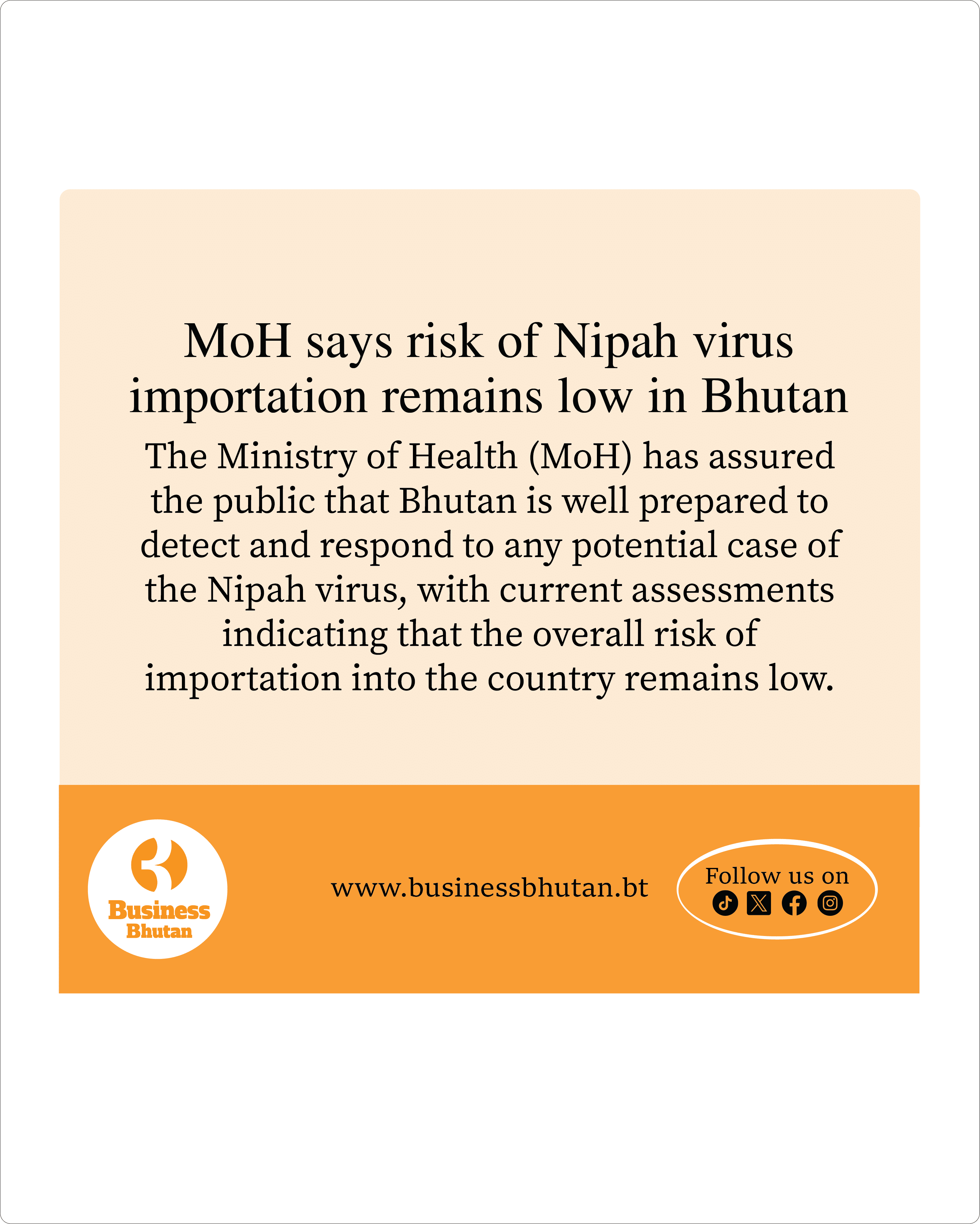
The Ministry of Health (MoH) has assured the public that Bhutan is well prepared to detect and respond to any potential case of the Nipah virus, with current assessments indicating that the overall risk of importation into the country remains low.
Karma Jamtsho, Director of the Department of Public Health, said comprehensive preparedness and response measures are in place, with the ministry working closely with the World Health Organization (WHO) to continuously assess the risk of international spread. All health facilities nationwide have been placed on high alert, while surveillance and monitoring have been strengthened in border areas to ensure early detection.
To prevent possible importation, the Ministry has activated its national surveillance system to identify and monitor suspected Nipah virus cases. Screening of high-risk travellers is underway at all points of entry, including international airports and ground crossings. Measures include mandatory health declarations, thermal and visual screening, and inflight health announcements for passengers arriving from high-risk areas.
The Royal Centre for Disease Control (RCDC) has conducted three rounds of risk assessments since the outbreak in West Bengal. The most recent assessment, carried out on February 2, 2026, reaffirmed that the likelihood of the virus entering Bhutan remains low.
Health authorities — including the Department of Public Health, RCDC, the Technical Advisory Group, and the Health Emergency Operation Center — are jointly monitoring developments, coordinating with point-of-entry health workers, and maintaining readiness for rapid response. The Ministry has also intensified public health advisories and communication efforts to keep citizens informed and promote early reporting of suspected cases.
Preventive guidance for the public is being reinforced. The Ministry advises people to wash fruits and vegetables thoroughly, avoid drinking raw date palm sap, refrain from consuming fruits that may have been contaminated by bats or animals, and avoid contact with bats, pigs, or sick animals in high-risk areas. Frequent handwashing, good respiratory hygiene, and avoiding close contact with individuals showing Nipah-like symptoms are also recommended, along with postponing unnecessary travel to affected regions.
Authorities urged the public not to circulate unverified information and to rely on updates from credible sources such as the MoH and WHO. Bhutan’s response strategy, officials said, will continue to evolve based on ongoing risk assessments.
According to the Ministry, the Nipah outbreak in West Bengal was confirmed on January 12, 2026. As of February 1, one patient had recovered and been discharged, while the second case was improving. All 196 identified contacts completed quarantine and tested negative, with no further spread detected. Health officials noted the outbreak remains localized and contained.
Nipah is a zoonotic virus that spreads primarily through direct contact with infected bats or pigs, or by consuming fruits or products contaminated by bat saliva or urine. Human-to-human transmission is possible but generally requires close contact. Symptoms typically appear within four to 14 days and begin with flu-like illness — fever, headache, muscle pain, vomiting, and sore throat — before potentially progressing to severe neurological or respiratory complications.
Classified as a biosafety level-four pathogen, Nipah is considered highly dangerous due to its high fatality rate and absence of approved vaccines or targeted treatments. Care is largely supportive, making prevention and rapid detection critical.
Despite the seriousness of the virus, Bhutanese health authorities emphasize that vigilance — combined with public cooperation — remains the country’s strongest defense. With surveillance systems active and preparedness measures in place, officials say Bhutan is well positioned to respond swiftly should the situation change.
Nidup Lhamo
From Thimphu