

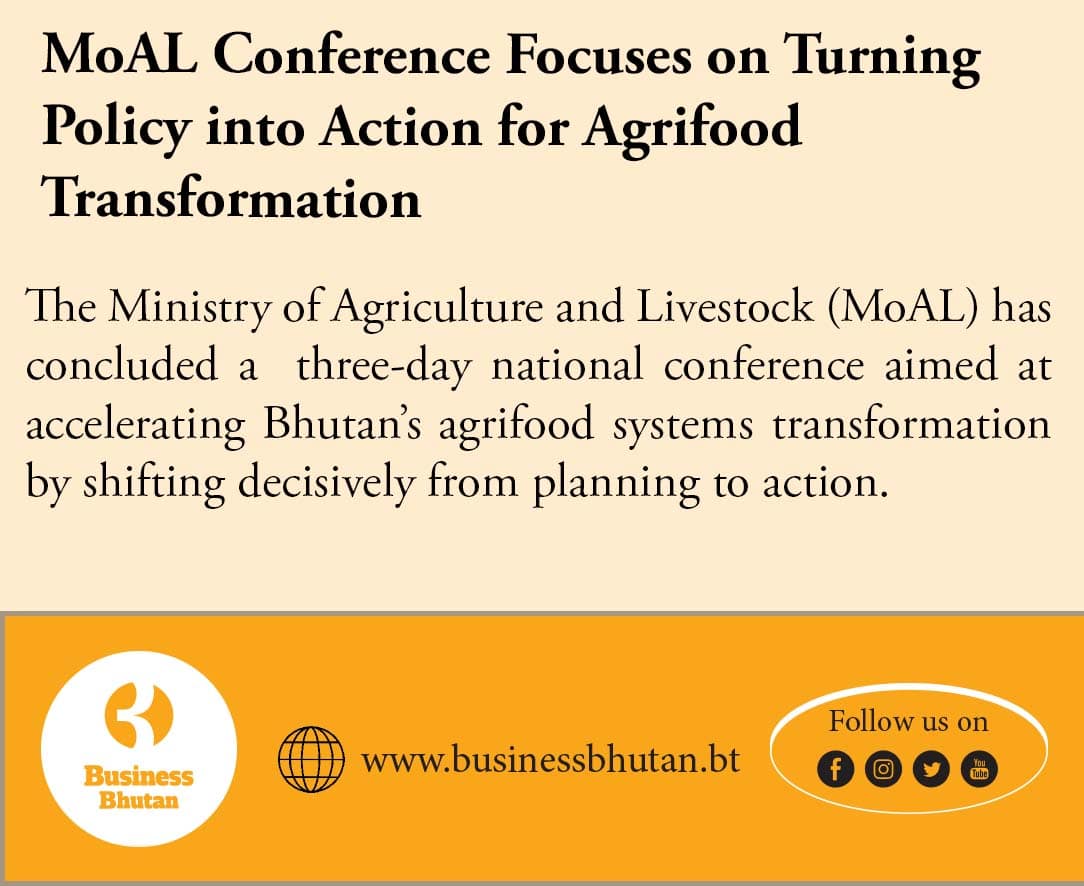
The Ministry of Agriculture and Livestock (MoAL) has concluded a three-day national conference aimed at accelerating Bhutan’s agrifood systems transformation by shifting decisively from planning to action. At a time when food security, rural livelihoods, and climate resilience are increasingly pressing national priorities, the conference served as a call to operationalize strategies and ensure that policy commitments translate into measurable results on the ground.
Held from March 25 to 27 at the Ugyen Wangchuck Institute of Forestry Research and Training in Lamaigoempa, Bumthang, the gathering brought together more than 130 participants under the theme “From Policy and Strategy to Implementation: Advancing Agrifood Systems Transformation.” Economic Development and Marketing Officers from all 20 dzongkhags joined policymakers, researchers, senior government officials, and frontline extension personnel to reassess current efforts and reaffirm collective goals.
Gracing the event, Lyonpo Younten Phuntsho, Minister for Agriculture and Livestock, delivered a keynote address that framed the urgency of the moment. He stressed that the sector is already midway through the 13th Five-Year Plan—a point at which, he said, the Ministry must “reset our priorities, scale what works, fix what doesn’t, and address what is missing.” Lyonpo Younten emphasized that success in agrifood transformation hinges on a unified approach that connects national policy with local-level realities and ensures that strategies do not remain confined to documents but reach farms, households and markets.
The Minister underscored that stronger vertical and horizontal coordination is essential. Departments, dzongkhags, gewogs and research institutions must no longer operate in silos, he said, because challenges such as rural–urban migration, climate variability, productivity gaps, and high import dependence cut across conventional bureaucratic boundaries. He highlighted the importance of evidence-based planning and encouraged participants—from extension officers to researchers—to align their efforts with Bhutan’s 21st Century Economic Roadmap and with national aspirations for self-reliance and resilience.
Throughout the three days, the conference served as a platform for critical review, dialogue, and problem-solving. Participants examined policy directions laid out in the 13th Five-Year Plan, with a particular focus on implementation gaps and opportunities for mid-course corrections. This included discussions on strengthening supply chains, improving production systems, modernizing agricultural services, and addressing systemic challenges that have slowed progress in recent years.
One of the central areas of deliberation was the National Crop and Livestock Insurance Scheme, a flagship initiative aimed at reducing vulnerability for farmers who face increasing climate-related risks. Several dzongkhags shared feedback on the scheme’s rollout, identifying both successes and bottlenecks. Participants emphasized that risk-mitigation measures must be complemented with stronger extension services, market access improvements, and timely compensation mechanisms if the insurance system is to serve its intended purpose.
Another major item on the agenda was the Cost Sharing Mechanism 2025, which seeks to enhance sector resilience through collaborative investment models. Officials reviewed the implementation status of the mechanism, recognizing its potential to empower farmers by lowering upfront costs for adopting improved technologies, diversifying production, and scaling commercial activities. Discussions also emphasized the need for clear guidelines, streamlined processes, and stronger monitoring frameworks to ensure equitable and efficient utilization.
The conference also highlighted the importance of strengthening linkages between research, policy, and practice. Researchers presented insights on emerging technologies, climate-smart practices, pest and disease surveillance, and high-value crop development. Many dzongkhags stressed the need for more frequent engagement with research institutes so that farmers receive solutions that is timely.
Organized in collaboration with the UN Food Systems Coordination Hub and the FAO of the United Nations, the conference benefited from global perspectives on sustainable food systems. International partners reaffirmed their support for Bhutan’s efforts to reduce import dependence, enhance rural incomes, and build climate-resilient agrifood systems.
The event concluded with a renewed commitment from all stakeholders to strengthen coordination, streamline implementation, and accelerate progress toward agrifood transformation.
Sangay Rabten
From Thimphu