

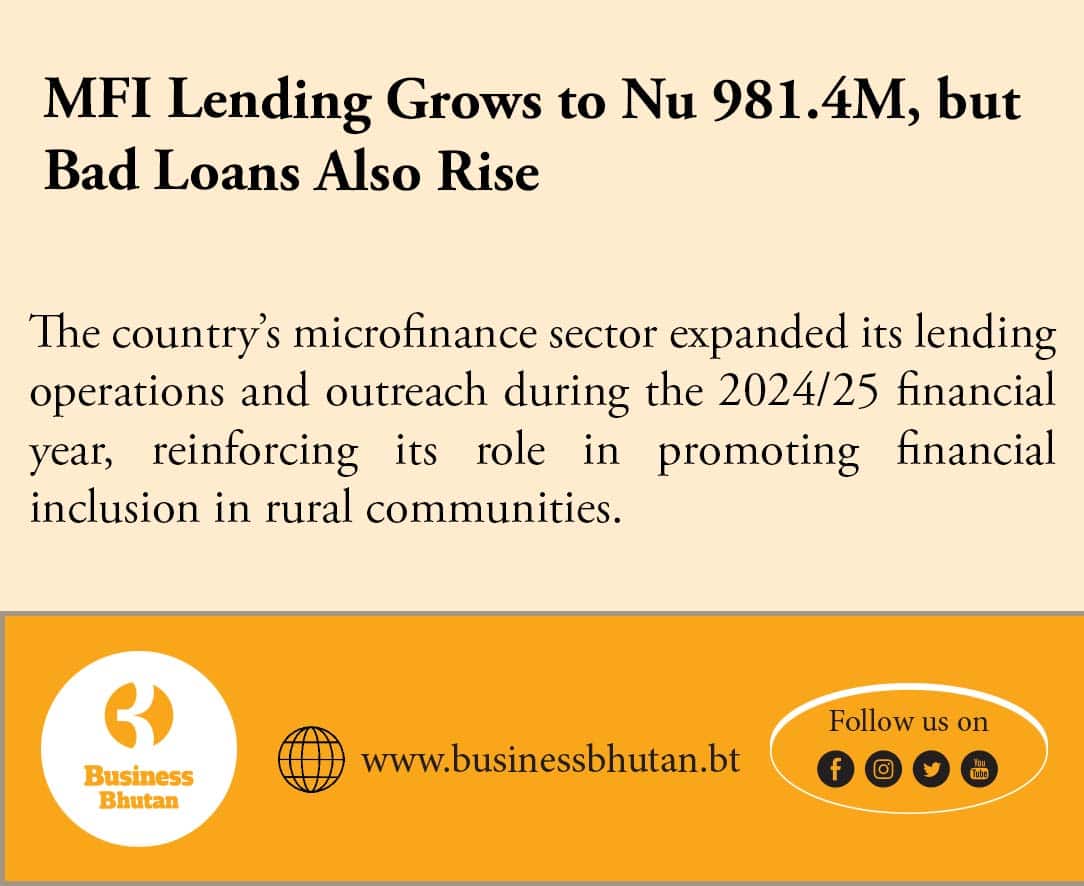
The country’s microfinance sector expanded its lending operations and outreach during the 2024/25 financial year, reinforcing its role in promoting financial inclusion in rural communities. However, the latest figures also point to rising repayment challenges, with non-performing loans increasing alongside overall loan growth.
According to the latest performance data, microfinance institutions (MFIs) in Bhutan sanctioned a total of Nu 981.4 million in loans as of FY 2024/25, up from Nu 729.6 million in the preceding year. The increase of more than Nu 251 million reflects growing demand for microfinance services, particularly among small borrowers, rural households, and entrepreneurs seeking access to financing outside the traditional banking system.
The sector also recorded an expansion in outreach. The total number of loan accounts increased by 636, rising from 4,980 in June 2024 to 5,616 in June 2025. This suggests that more people are turning to MFIs for credit support, underlining the continued relevance of microfinance in extending financial services to underserved populations.
Microfinance institutions have long played an important role in Bhutan’s rural economy by mobilizing savings and deposits and by providing small loans to individuals and groups who may otherwise face difficulties accessing formal credit. In many parts of the country, these institutions serve as a key financial lifeline for low-income households, small farmers, women entrepreneurs, and informal businesses.
The latest figures show that the overall loan outstanding in the sector also increased, rising from Nu 533.5 million in FY 2023/24 to Nu 664 million in FY 2024/25. This indicates not only greater loan disbursement, but also a larger active credit portfolio being managed by the institutions.
Financial observers say the expansion reflects a steady increase in demand for small-scale loans for agriculture, petty trade, livestock activities, household enterprises, and other income-generating ventures. The growing loan portfolio also suggests that microfinance continues to fill an important gap in the financial system, especially in communities where access to commercial banking remains limited.
Among the players in the sector, Microfinance Bhutan Private Limited (MBPL) held the largest share of the total portfolio at 36.3 percent, with a total loan amount of Nu 142.7 million. It was closely followed by RENEW Microfinance, which accounted for 34.6% of the portfolio with a total loan amount of Nu 135.9 million.
The strong share held by these institutions highlights their central role in the country’s microfinance landscape. Their presence has been particularly significant in reaching vulnerable and underserved groups, including women, rural borrowers, and clients operating on a small scale. Market watchers say the continued prominence of MBPL and RENEW Microfinance reflects both institutional experience and a growing trust among borrowers.
While the sector’s lending growth is a positive sign, the data also reveal growing concerns over asset quality.
Total non-performing loans (NPLs) rose from Nu 39.8 million in FY 2023/24 to Nu 53.4 million in FY 2024/25. Consequently, the NPL-to-loan ratio increased from 7.5% to 8%, representing a marginal rise of 0.5 percentage points over the year.
Although the increase may appear moderate, it signals that a larger share of borrowers is facing difficulties in meeting repayment obligations. In the context of microfinance, where institutions often work with small borrowers who are highly vulnerable to income shocks, even a slight rise in bad loans can be a matter of concern.
Analysts say the deterioration in asset quality could be linked to several factors, including economic pressures on rural households, fluctuations in income, rising living costs, and challenges faced by micro and small enterprises. Borrowers in agriculture and informal sectors are often more exposed to seasonal volatility, market disruptions, and unexpected expenses, all of which can affect repayment capacity.
At the same time, experts note that rising NPLs do not necessarily diminish the overall value of microfinance expansion. Rather, they point to the need for stronger credit assessment, better monitoring of borrowers, timely recovery efforts, and financial literacy support to ensure that growth remains sustainable.
The increase in non-performing loans underscores the importance of balancing social outreach with sound financial discipline. As institutions expand lending to more clients, particularly first-time or higher-risk borrowers, robust internal controls become increasingly important. This includes careful borrower screening, regular follow-up, repayment support mechanisms, and more responsive risk management practices.
Despite these challenges, the sector’s broader contribution to national development remains significant. MFIs play an essential role in improving access to finance for people who may not qualify for conventional bank loans due to limited collateral, low or irregular income, or remote location. By extending small-scale credit and encouraging savings habits, microfinance institutions help support entrepreneurship, household resilience, and local economic activity.
For many borrowers, access to microfinance can make a tangible difference in their livelihoods. Small loans can be used to buy seeds and fertilizer, invest in livestock, open or expand petty shops, start home-based production, or cover urgent working capital needs. In this way, microfinance supports not only financial inclusion, but also rural self-employment and grassroots economic participation.
The latest data therefore present a mixed but meaningful picture of Bhutan’s microfinance sector. On one hand, lending volume, loan accounts, and outstanding portfolios all increased, indicating broader reach and stronger activity. On the other, the rise in bad loans signals the need for greater caution and stronger portfolio management to protect the long-term health of the sector.
As Bhutan continues to prioritize inclusive economic development, the role of MFIs is expected to remain important, particularly in rural and underserved communities. Their ability to mobilize savings, provide small loans, and create financial access at the grassroots level makes them a valuable part of the broader financial ecosystem.
However, the latest figures make it clear that growth alone is not enough. The sustainability of the microfinance sector will depend on how effectively institutions manage rising credit risks while continuing to serve the people who need them most.
With total loan sanctions reaching Nu 981.4 million and outreach continuing to expand, Bhutan’s MFIs have demonstrated their growing importance in the national economy. But with non-performing loans also climbing to Nu 53.4 million, the sector faces a parallel challenge: ensuring that progress in access to finance is matched by stronger repayment performance and prudent risk management.
Tashi Namgyal
From Thimphu