

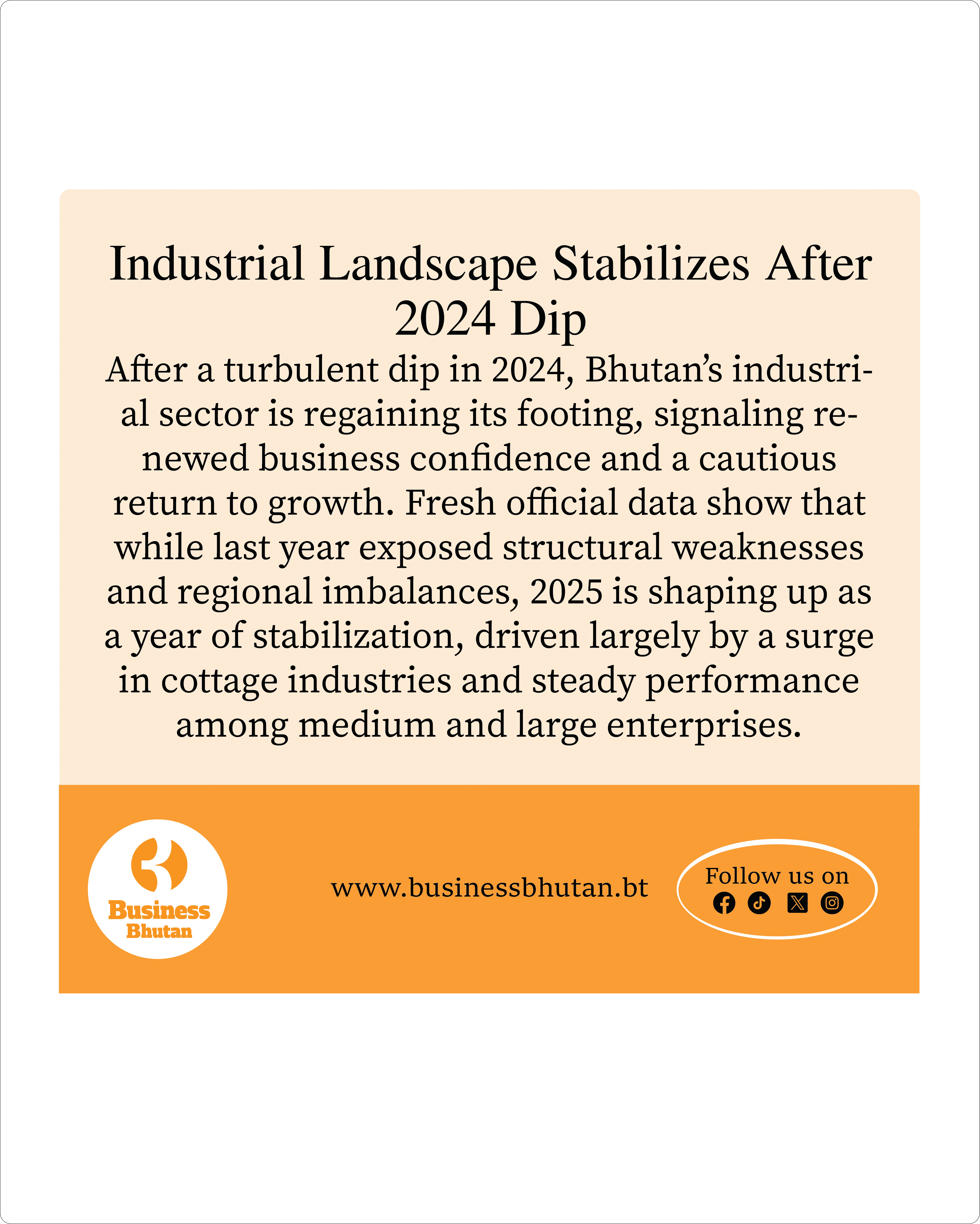
After a turbulent dip in 2024, Bhutan’s industrial sector is regaining its footing, signaling renewed business confidence and a cautious return to growth. Fresh official data show that while last year exposed structural weaknesses and regional imbalances, 2025 is shaping up as a year of stabilization, driven largely by a surge in cottage industries and steady performance among medium and large enterprises.
At the heart of this recovery is Thimphu, which continues to dominate Bhutan’s industrial activity across all scales. Yet policymakers warn that unless growth is spread more evenly across Dzongkhags, long-term resilience and inclusive development will remain elusive.
From Contraction to Comeback
The numbers tell a compelling story. In 2023, Bhutan recorded 31,707 active industrial licenses nationwide. That figure fell sharply in 2024 to 29,819, which is a decline of nearly six percent. The contraction reflected a mix of business closures, license non-renewals, and lingering post-pandemic adjustments as firms struggled with costs, demand shifts, and financing constraints.
In 2025, however, the tide began to turn. Active licenses rose to 30,666, marking a 2.84 percent year-on-year increase. While still below the 2023 peak, the rebound signals that the worst of the post-pandemic shock may be over.
Officials engaged with the Industrial sector and business say the stabilization points to improving confidence, even as businesses remain cautious. “This is not a boom,” one official noted, “but it is a clear sign that the sector is finding its balance again.”
Cottage Industries Power Ahead
The most striking trend is the sustained rise of cottage industries, which have emerged as the quiet engine of Bhutan’s industrial recovery. Cottage licenses increased steadily from 9,738 in 2023 to 10,478 in 2024 and surged further to 11,154 in 2025.
This growth contrasts sharply with the volatility seen in other segments and underscores the resilience of micro-entrepreneurs, artisans, and small family-run businesses. With lower capital requirements and flexible operations, cottage industries have proven better able to adapt to economic uncertainty.
Small-scale industries, long considered the backbone of the economy, faced a sharper setback—falling from 20,603 licenses in 2023 to 18,137 in 2024. A modest recovery followed in 2025, with licenses inching up to 18,255, suggesting stabilization rather than strong expansion.
Medium industries mirrored this pattern, declining from 911 licenses in 2023 to 777 in 2024, before rebounding to 821 in 2025. Large industries remained relatively stable throughout, with only minor fluctuations—455 in 2023, 427 in 2024, and 436 in 2025—highlighting their stronger capacity to weather economic shocks.
Taken together, the data point to a sector increasingly diversified at the base, with cottage industries driving growth and larger firms providing stability.
Services Still Rule the Economy
Despite shifts within industrial scales, Bhutan’s economy remains overwhelmingly service-driven. In 2025, the services sector accounted for nearly 80 percent of all active industrial licenses.
After dropping from 25,670 licenses in 2023 to 23,954 in 2024, services rebounded modestly to 24,463 in 2025. Tourism, hospitality, consultancy, automobile services, and financial services continue to dominate, reinforcing Bhutan’s service-oriented development model.
The Production and Manufacturing (P&M) sector, however, delivered one of the strongest growth stories. Licenses rose consistently—from 3,712 in 2023 to 3,839 in 2024, and then jumped to 4,351 in 2025—signalling renewed momentum in value addition, agro-based processing, and manufacturing activities.
In contrast, the construction sector remains a concern. Licenses declined steadily from 2,325 in 2023 to just 1,852 in 2025, reflecting a slowdown in construction activity, delayed projects, and tighter financing conditions.
Thimphu Leads, Regions Lag
Industrial growth remains highly uneven across the country. Thimphu hosts the largest concentration of industries at every scale, reaffirming its role as Bhutan’s economic nerve centre. Dzongkhags such as Chhukha, Samtse, Paro, Sarpang, and Samdrup Jongkhar follow, benefiting from better infrastructure, industrial parks, and proximity to major trade routes.
Large industries are particularly concentrated in Chhukha, Samtse, Sarpang, and Thimphu—areas with stronger logistics, power supply, and market access.
At the other end of the spectrum, Dzongkhags like Gasa, Lhuentse, and Haa record the fewest industries. Geographic isolation, limited infrastructure, and small local markets continue to constrain industrial activity in these regions.
Across all Dzongkhags, small-scale industries dominate, reinforcing their role as the foundation of Bhutan’s industrial economy—but also highlighting limited scale-up opportunities outside major hubs.
Who Owns Bhutan’s Industries?
Ownership patterns reveal another defining feature of the industrial landscape. Sole proprietorships account for an overwhelming 96 percent of all active industries, particularly in the cottage and small-scale segments. These enterprises are often informal, family-run, and highly dependent on individual entrepreneurs.
Company-owned businesses are more common among medium and large industries, while partnerships, cooperatives, government-owned, and Dratshang-owned enterprises make up only a marginal share.
This dominance of sole proprietorships underscores both the entrepreneurial spirit of Bhutanese businesses and the need for stronger support systems to help firms scale up, formalize, and professionalize.
A Call for Smarter, Targeted Policies
Industries in Bhutan are classified into four scales—cottage, small, medium, and large—based on capital investment and employment, with investment levels taking precedence where criteria differ. They are also grouped into P&M, services, and construction sectors, each facing distinct challenges and opportunities.
While the rebound in licenses, growth in cottage industries, and stability among larger firms point to recovery, authorities acknowledge that the story is incomplete. Declining construction activity, heavy dependence on services, and stark regional imbalances raise red flags.
Policymakers say the next phase must focus on targeted industrial policies—promoting balanced regional growth, encouraging diversification, and creating pathways for cottage and small firms to scale up, especially in underdeveloped Dzongkhags.
“The recovery is real,” an official said, “but to make it sustainable, growth must reach beyond Thimphu and empower industries across the country.”
As Bhutan’s industrial sector steadies itself after the 2024 dip, the challenge now is clear: turn stabilization into transformation—and ensure that growth is not just stronger, but fairer and broader.
Tashi Namgyal
From Thimphu