

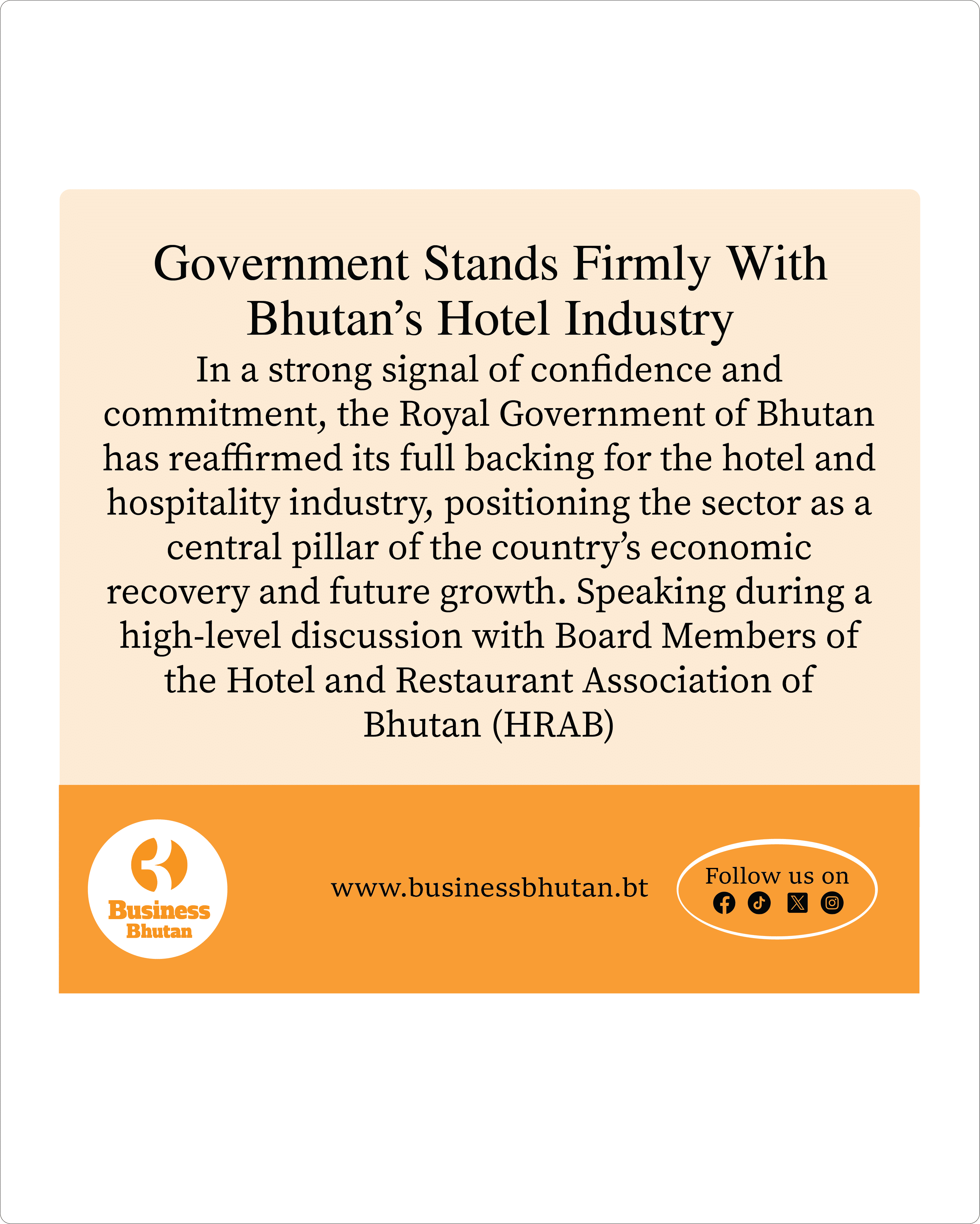
In a strong signal of confidence and commitment, the Royal Government of Bhutan has reaffirmed its full backing for the hotel and hospitality industry, positioning the sector as a central pillar of the country’s economic recovery and future growth. Speaking during a high-level discussion with Board Members of the Hotel and Restaurant Association of Bhutan (HRAB), the Minister (Lyonpo) for Industry, Commerce and Employment (MoICE), Namgyal Dorji, delivered a clear message that the government stands firmly with hotels and restaurants as they navigate the difficult post-pandemic landscape.
The meeting, described by participants as candid and forward-looking, came at a time when the hospitality sector is still grappling with debt stress, operational challenges, and the long shadow of COVID-19. “Our engagement with the sector has been steady and deliberate,” the Minister said. “We fully recognize the immense difficulties hotels and restaurants have faced since the pandemic, and we are doing everything we responsibly can to support the sector during these challenging times.”
Unprecedented Loan Relief for Hotels
At the heart of the discussion was the government’s extraordinary intervention in easing financial pressure on hotels. Lyonpo Namgyal highlighted that no other sector in the economy has received such sustained and focused loan support.
Since the onset of the pandemic, hotel loans have undergone multiple rounds of relief, starting with initial deferments, followed by extensions from June 2024 to June 2025, then from September to December 2025. Just this week, another deferment was approved, pushing repayment obligations to the end of January.
“These decisions were not routine,” Lyonpo emphasized. “They reflect our serious commitment to addressing the unique challenges faced by the hospitality sector. No other sector has received this level of focused attention.”
For many hotel owners, these deferments have been the difference between survival and closure, buying crucial time for demand to recover and revenues to stabilize.
Cabinet Considers Major Restructuring Package
Beyond deferments, the government is now considering a more structural response. The Minister revealed that seven loan restructuring options, coupled with a four percent interest subsidy, have been proposed by MoICE and the Royal Monetary Authority (RMA) through the Economic Stimulus Program (ESP) Steering Committee. The package is currently under Cabinet review.
“These measures are designed to provide real breathing space,” the Minister said. “They are not perfect solutions, but they are tangible efforts with meaningful benefits. Combined with the additional time already granted, they are meant to help hotels regain stability and confidence.” If approved, the package could significantly ease debt servicing costs and restore financial viability for many struggling hospitality businesses.
Tourism Numbers Signal a Turnaround
Crucially, the government believes the worst may be over. Tourism indicators are showing clear signs of revival, injecting optimism into an industry that has endured years of uncertainty.
“This year, tourist arrivals have crossed 200,000—around 50,000 more than last year,” Lyonpo Namgyal noted. “MICE tourism is picking up strongly, and many hotels are reporting full occupancy for both rooms and conference halls.”
For a sector battered by border closures and global travel disruptions, these numbers are more than statistics—they are proof that demand is returning and that Bhutan’s tourism model is regaining traction.
Skills, Careers, and a Strong Brand
However, recovery alone is not enough. The Minister stressed that the future of the hospitality sector must be built on skills, professionalism, and a strong national brand.
“Jobs alone are not enough,” MoICE’s minister said. “That is why we have launched the National Career and Occupational Framework for tourism and hospitality. It focuses on skills development, service excellence, and ensuring decent income for workers.”
Equally important, he added, is protecting Bhutan’s global image. “Bhutan is a high-value, aspirational destination. We must be proud of our unique identity and avoid diluting our brand by constantly justifying or explaining costs. Our value proposition speaks for itself.”
Lessons from the Pre-COVID Boom
Reflecting on the pre-pandemic tourism boom, often remembered as the industry’s golden era, the Minister offered a more nuanced perspective. He noted that many experienced tour operators now acknowledge that 2019, while financially strong, was also one of the most difficult periods from a policy and brand standpoint.
“Over-tourism put pressure on sacred sites and diluted the Bhutan experience,” he said. “The pandemic, painful as it was, gave us the opportunity to reset, correct imbalances, and refocus on quality over quantity.”
Tightening Governance, Plugging Leakages
The government is also intensifying efforts to improve standards and governance across the tourism value chain. Addressing concerns over foreign agent dominance and revenue leakages, the Minister welcomed the hospitality sector’s participation in the Tourist Registration System.
“We are grateful to hotels for joining the system,” he added. “It will soon be linked with Immigration, which will significantly improve planning, transparency, and governance.”
Looking ahead, projections for 2026 remain highly positive, further reinforcing the government’s optimism.
No Blame Game, Only Shared Responsibility
In a notable departure from blame-driven narratives, the Minister urged stakeholders to move past criticism of past policies and incentives.
“Blaming previous governments helps no one,” Lyonpo said. “Every decision was taken with good intent and in the country’s best interest. Instead, we should express gratitude for the support that helped build this sector and protect jobs, especially during COVID.”
A Call for Unity and Trust
The meeting concluded on a message of unity and resolve. While acknowledging that challenges remain, the Minister made it clear that the government is acting responsibly, decisively, and in partnership with the private sector.
“The results are slowly showing,” he said. “What we need now is trust and shared effort. Instead of looking for someone to blame, we must work together to ensure that Bhutan’s hospitality sector emerges stronger, more resilient, and future-ready.”
Looking at what the Minister has said, it appears that the government is not stepping back in assisting hoteliers. Rather, it is stepping in.
Sherab Dorji
From Thimphu