

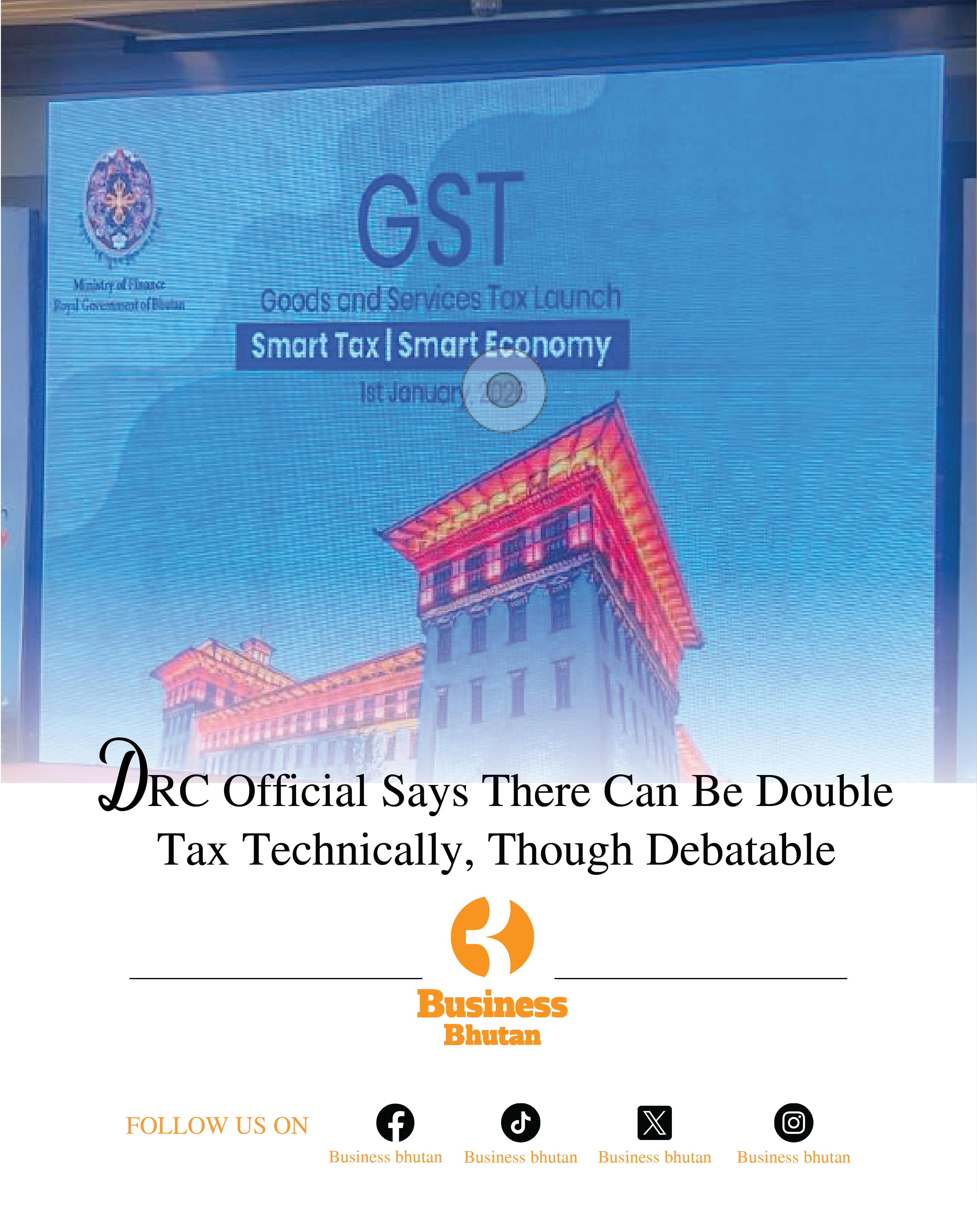
Bhutan’s biggest tax reform in decades has triggered its fiercest public debate yet. Barely weeks after the Goods and Services Tax (GST) came into force on January 1, 2026, a pressing question is echoing across markets, households, and social media: Are people being taxed twice?
The GST was introduced to replace a complex web of indirect taxes with a single, transparent system. In theory, it was meant to simplify taxation, widen the tax base, and reduce leakages. In practice, however, the transition has brought confusion, rising prices, and growing anxiety, especially among middle-class families already struggling with the cost of living.
Officials from the Department of Revenue and Customs (DRC) admit that the issue of “double taxation” during the transition phase is not entirely unfounded.
“Technically, There Can Be Double Tax”
The Head of the Revenue Intelligence Division at the DRC, Pema Wangdi, acknowledged that technically, double taxation can occur under GST, though he stressed that the issue remains debatable.
“Double taxation in the GST context refers to situations where the same goods are effectively taxed more than once,” he explained. “This mainly happens during the transition, especially with pre-GST stocks.”
Under the old tax regime, goods imported before January 1, 2026, had already been taxed at the point of entry. When these same goods are later sold under the GST system, GST is applied again at the point of sale. As GST is a consumption-based tax, the levy becomes embedded in the final retail price—creating what many consumers perceive as a double tax burden.
“Technically, there is double taxation with GST during the transition,” Pema Wangdi said. “Taxes were already paid under the old regime. Now, with GST crystallized into the price, those costs are passed on to consumers.”
No Refunds, No Adjustments
According to the DRC, the government cannot adjust or refund taxes already paid on pre-GST imports. Once GST is implemented, the old taxes are considered sunk costs, and the selling price becomes the base on which GST is applied.
“The cost of the goods becomes the sale value,” Pema Wangdi clarified. “It should cease with the cost. There is no provision under the new tax policy to refund or offset old taxes.”
While officials insist this is a temporary phenomenon, for consumers, the impact is immediate—and painful.
Prices Will Stabilize, Officials Say
Director General of the DRC, Sonam Jamtsho, urged patience, assuring the public that price pressures will ease once old stocks are exhausted.
“This situation will not last,” he said. “Once businesses finish selling pre-GST stocks and begin importing fresh goods under the new GST regime, prices will come down.”
The DRC estimates that old stocks will be cleared within three months. After that, goods will be taxed only once under GST, eliminating the perception—and reality—of double taxation.
But for now, households are being asked to absorb the shock.
Public Outcry Grows
On the streets of Thimphu and other regions, frustration is palpable.
Ugyen, a resident of the capital, believesAs consumers are clearly being taxed twice. “Tax is levied once at the entry point and again at the point of sale,” he said. “Even if it’s not directly charged twice to the end consumer, it is taxed twice somewhere—and we pay for it.”
Pema Lhazom echoed the sentiment. “At the end of the day, it is we, the consumers, who bear the burden,” she said. “Prices have gone up everywhere.”
From Samtse, Sarjana Gurung painted a starker picture of everyday struggles. “Life has become increasingly difficult for ordinary middle-class families,” she said. “With one earning member and small children, almost everything now carries a tax—groceries, daily necessities, essentials.”
“Just thinking about the rising cost of living is exhausting,” she added. “Development is important, but policies should not constantly burden common people and take away their sense of security and happiness.”
Short-Term Pain, Long-Term Gain?
DRC officials maintain that the price increase is short-term and largely unavoidable during a major tax transition. They concede that consumers will have to bear the cost temporarily but argue that the long-term benefits outweigh the immediate discomfort.
Finance Minister Lekey Dorji defended the GST, saying its core objective is to broaden the tax base, improve compliance, and reduce corruption.
“The GST is designed to make taxation more transparent and reduce opportunities for corruption,” he said. “It supports a wellbeing-oriented economy aligned with Gross National Happiness.”
Supporters of the reform argue that GST will eventually lead to fairer taxation, better public services, and a more stable revenue system. Critics, however, question whether the timing and implementation could have been managed better to protect vulnerable households.
The Real Test for GST
The GST has become more than a tax. It is a stress test of public trust. While officials emphasize that the double taxation effect is temporary, the public judges the reform by what they experience at shop counters today, not by promises of tomorrow.
As Bhutan navigates this transition, the coming months will be critical. If prices stabilize as promised and transparency improves, GST could mark a turning point in the country’s fiscal system. If not, the perception of being “taxed twice” may harden into lasting resentment.
For now, one thing is clear: the GST debate has only just begun, and the cost of transition is being felt most sharply by ordinary Bhutanese families.
Sangay Rabten
From Thimphu