

Bhutan is poised for a hydropower revolution. The 1,125 MW Dorjilung Hydroelectric Power Project (DHPP) is more than an infrastructure venture. It is a game-changer that could lift the nation’s Gross Domestic Product (GDP) by 0.6% during construction and an estimated 2.4% once operational, transforming the country’s economic and social landscape.
For decades, Bhutan’s hydropower story has been dominated by government-to-government debt agreements, but Dorjilung signals a fundamental shift. It is the nation’s largest hydropower project developed under a Public-Private Partnership (PPP), with 60% ownership by the Druk Green Power Corporation (DGPC) and 40% by Tata Power Company. This pioneering structure positions Bhutan as a hub for modern, investment-driven energy development.
The project is managed by a special purpose vehicle, Dorjilung Hydro Power Limited (DHPL), which is mobilizing USD 815 million in financing from the World Bank Group. Once completed, Dorjilung will increase Bhutan’s energy production by 40%, generating over 4,500 GWh annually, and substantially boosting electricity exports.
The World Bank package is a carefully structured mix of grants and loans, including a USD 150 million grant and a USD 150 million credit from the IDA, a USD 15 million enclave loan to DGPC, a USD 200 million IBRD loan, and a USD 300 million IFC loan to DHPL. Finance Minister Lekey Dorji described Dorjilung as a national priority, highlighting its role in delivering clean electricity, driving economic growth, and reinforcing Bhutan’s carbon-negative commitment. The innovative financing ensures public finances remain insulated, allowing the government to continue social spending without compromise.
Beyond economics, Dorjilung embeds social safeguards for local communities in Mongar and Lhuentse, districts grappling with high poverty, unemployment, and out-migration. The project is expected to generate thousands of jobs during both construction and operational phases, alongside critical infrastructure upgrades. To prevent social risks, DHPL has partnered with RENEW to implement a legally mandated framework to address gender-based violence. Additionally, the project includes hydrogeological surveys to secure local drinking water and irrigation during tunneling.
Energy security is another cornerstone. While Bhutan is a net electricity exporter, winter months historically demand costly imports from India, projected to reach 1,100 MW this year. Dorjilung will bridge this deficit, supplying reliable electricity year-round. About 80% of generated power will be exported to India via a new 400-kilovolt transmission line linked to a pooling station at Durungri, while domestic supply will benefit from peaking pondage that allows the plant to generate peak power for up to eight hours daily.
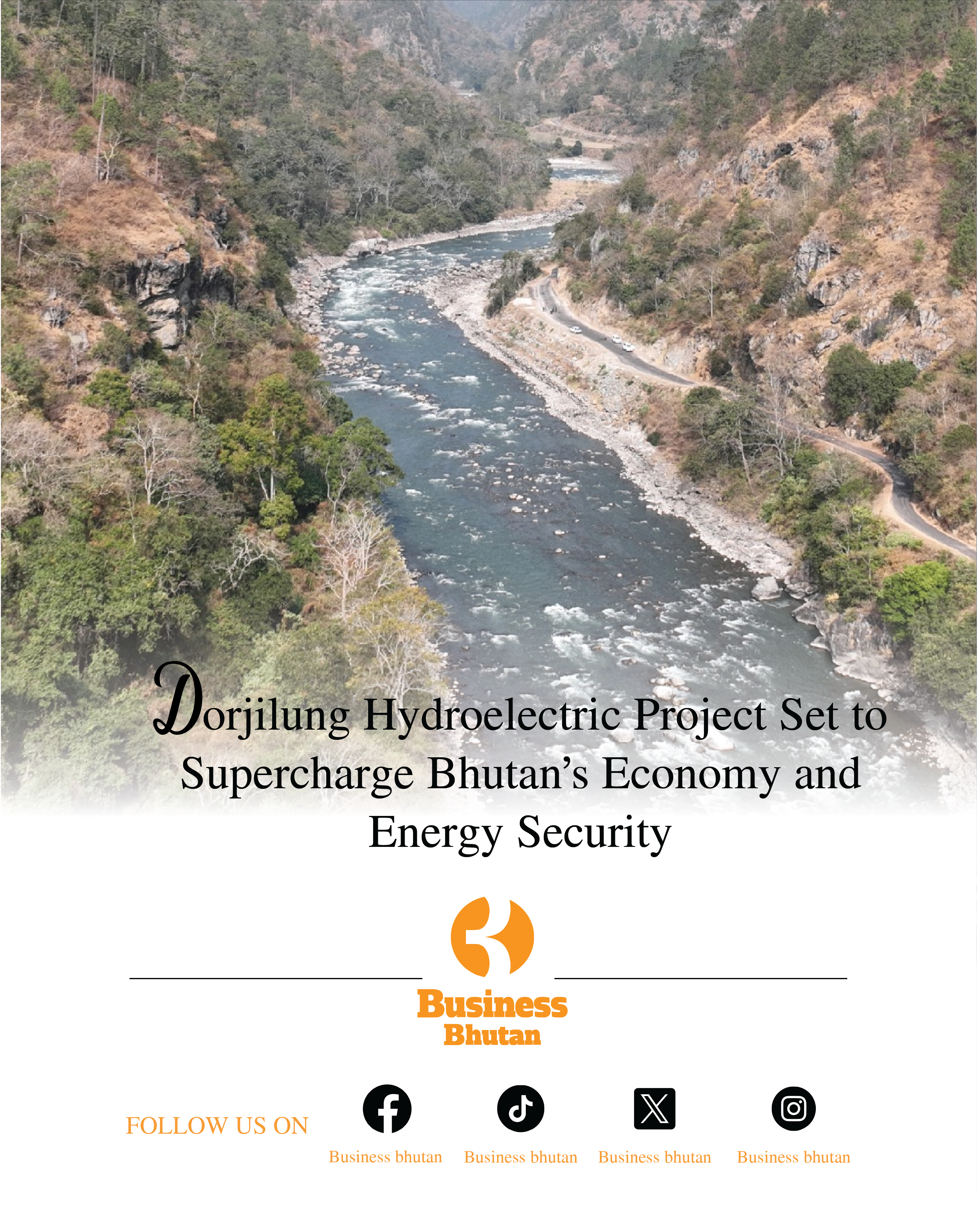
Preparatory works are underway, including 29 kilometers of access roads, paving the way for construction of a 136.5-meter-high dam and a 15-kilometer headrace tunnel, employing around 6,000 workers. Full commissioning is expected by September 2031, positioning Bhutan as a regional energy powerhouse.
Despite its promise, Dorjilung carries high environmental risks, according to the World Bank. The reservoir will submerge about 900 acres of State Reserve Forest and intersect Biological Corridor No. 7 (BC7), a critical wildlife bridge connecting Phrumsengla National Park and Bumdeling Wildlife Sanctuary. BC7 is vital for endangered species, including Bengal tigers and red pandas.
To mitigate these risks, DHPL has committed to maintaining environmental flows along a 16-km dewatered stretch of the Kurichhu River, ensuring the protection of aquatic life and surrounding habitats. These measures demonstrate that economic development and environmental stewardship can advance hand in hand.
Dorjilung is not just a project; it is a symbol of Bhutan’s future, uniting economic growth, energy security, and social responsibility. By leveraging private investment, creating jobs, strengthening local communities, and safeguarding critical ecosystems, the project exemplifies Bhutan’s vision of sustainable development with global impact.
In the words of Finance Minister Lekey Dorji, “Dorjilung is a national priority. It will deliver clean electricity, fuel economic growth, and fortify Bhutan’s commitment to a carbon-negative future.” As construction progresses, Bhutan is set to light up its economy and energize its people, proving that visionary infrastructure can transform not just landscapes, but livelihoods, for generations to come.
Nidup Lhamo
From Thimphu