

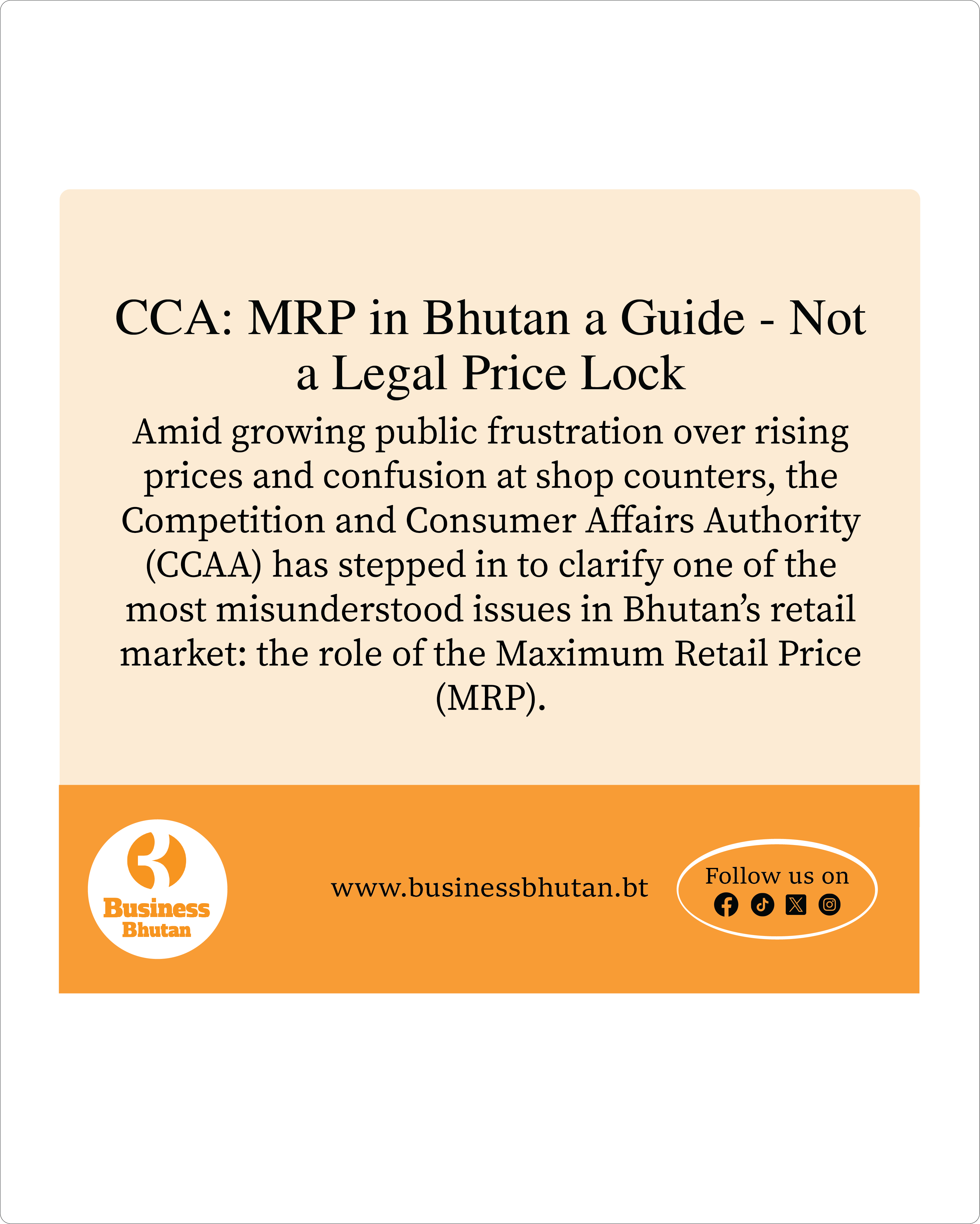
Amid growing public frustration over rising prices and confusion at shop counters, the Competition and Consumer Affairs Authority (CCAA) has stepped in to clarify one of the most misunderstood issues in Bhutan’s retail market: the role of the Maximum Retail Price (MRP). Contrary to widespread belief, the CCAA has made it clear that MRP printed on imported goods is not a legally binding price ceiling in Bhutan, but rather a reference point meant to guide consumers.
The clarification comes in response to increasing queries from both consumers and businesses, many of whom have questioned whether retailers are legally obligated to sell goods at or below the printed MRP—particularly for products imported from India, where MRP enforcement is strict.
MRP is Information
According to the CCAA, the MRP serves an important function—but not the one many assume. “MRP is a valuable source of price information for consumers,” the authority said, emphasizing that under Bhutan’s Consumer Protection Act, 2012, businesses are required not to conceal, misrepresent, or obscure price information. Transparency, the authority stressed, is the cornerstone of fair market practice.
In other words, consumers have the right to see and understand the MRP—but not necessarily to demand that the product be sold at that price.
This distinction is critical in Bhutan’s decentralized and competitive market system, where prices are shaped not by government mandate but by real-world factors such as transportation costs, scale of operation, efficiency, and location.
Why Bhutan Doesn’t Cap Prices at MRP
The CCAA explained that Bhutan’s market structure allows retailers to set prices based on their actual costs. This flexibility, it argued, is not a flaw—but a strength.
“In a competitive environment, businesses often sell goods below MRP,” the authority noted, adding that many retailers pass on cost efficiencies to consumers. From bulk purchasing to streamlined logistics, competition pushes prices down—often benefiting shoppers far more than a rigid price cap ever could.
Making MRP legally binding, the CCAA warned, could distort competition, discourage innovation, and reduce incentives for efficiency. More worryingly, it could hit small and remote retailers the hardest.
In far-flung gewogs and high-altitude communities, shopkeepers face higher transportation costs, limited supply chains, and lower sales volumes. A strict MRP ceiling could make it impossible for them to recover costs, forcing shops to close and leaving consumers with fewer choices—or none at all.
Not CCAA’s Legal Mandate
The authority was also unequivocal about its own role. “The CCAA is not the competent authority to make MRP legally enforceable in Bhutan,” it said.
Even if such a policy were to be considered at a higher level, enforcement would be a logistical nightmare. Thousands of products enter Bhutan from different countries, each with unique cost structures and supply chains. While Indian goods carry MRPs, products from Thailand, Korea, Singapore, and other countries often do not.
“How would MRPs be determined for those products?” the CCAA questioned, pointing out that such a system would impose massive administrative burdens with no clear evidence of consumer benefit.
When Price Controls Do Make Sense
While rejecting blanket price controls, the CCAA acknowledged that price regulation has a role in exceptional circumstances. These include national emergencies, severe supply disruptions, or sectors where competition cannot function naturally—such as natural monopolies or quota-restricted markets.
In such cases, temporary and targeted price controls may be justified to protect consumers from exploitation. Outside these narrow conditions, however, the authority believes that market-driven pricing supported by strong consumer protection laws remains the most effective safeguard.
GST Violations: A Red Line
On a related and sensitive issue, the CCAA addressed public complaints about incorrect or misleading Goods and Services Tax (GST) charges. While GST policy itself falls under the Ministry of Finance and the Department of Revenue and Customs, the authority made it clear that it will act when GST violations mislead consumers.
“If businesses misrepresent prices by charging GST incorrectly, it constitutes misleading conduct under Section 7 of the Consumer Protection Act, 2012,” the CCAA said.
The consequences for such violations are serious. Under Sections 78 and 79 of the Act, businesses can face fines for first-time offences. Repeated violations may result in harsher penalties, including revocation of business licences.
This, the authority stressed, is where its enforcement power comes into full effect—not in fixing prices, but in protecting consumers from deception and unfair practices.
The Bigger Picture: Trust, Transparency, and Choice
At its core, the CCAA’s message is about balance. MRPs should inform consumers, not shackle businesses. Competition should drive prices, while regulation ensures honesty and fairness.
“In short, MRPs should serve as informational reference points rather than mandatory price ceilings,” the authority said, adding that a competitive, rules-based market backed by strong consumer protection is the best way to ensure fair prices, sustainable businesses, and long-term consumer welfare in Bhutan.
As inflation pressures and cost-of-living concerns continue to dominate public discourse, the clarification offers much-needed perspective. For consumers, it underscores the importance of awareness and informed choice. For businesses, it reaffirms the space to operate competitively—so long as they play by the rules.
In Bhutan’s evolving market economy, the message is clear: fair prices are best achieved not through rigid controls, but through transparency, competition, and accountability.
Sangay Rabten
From Thimphu