

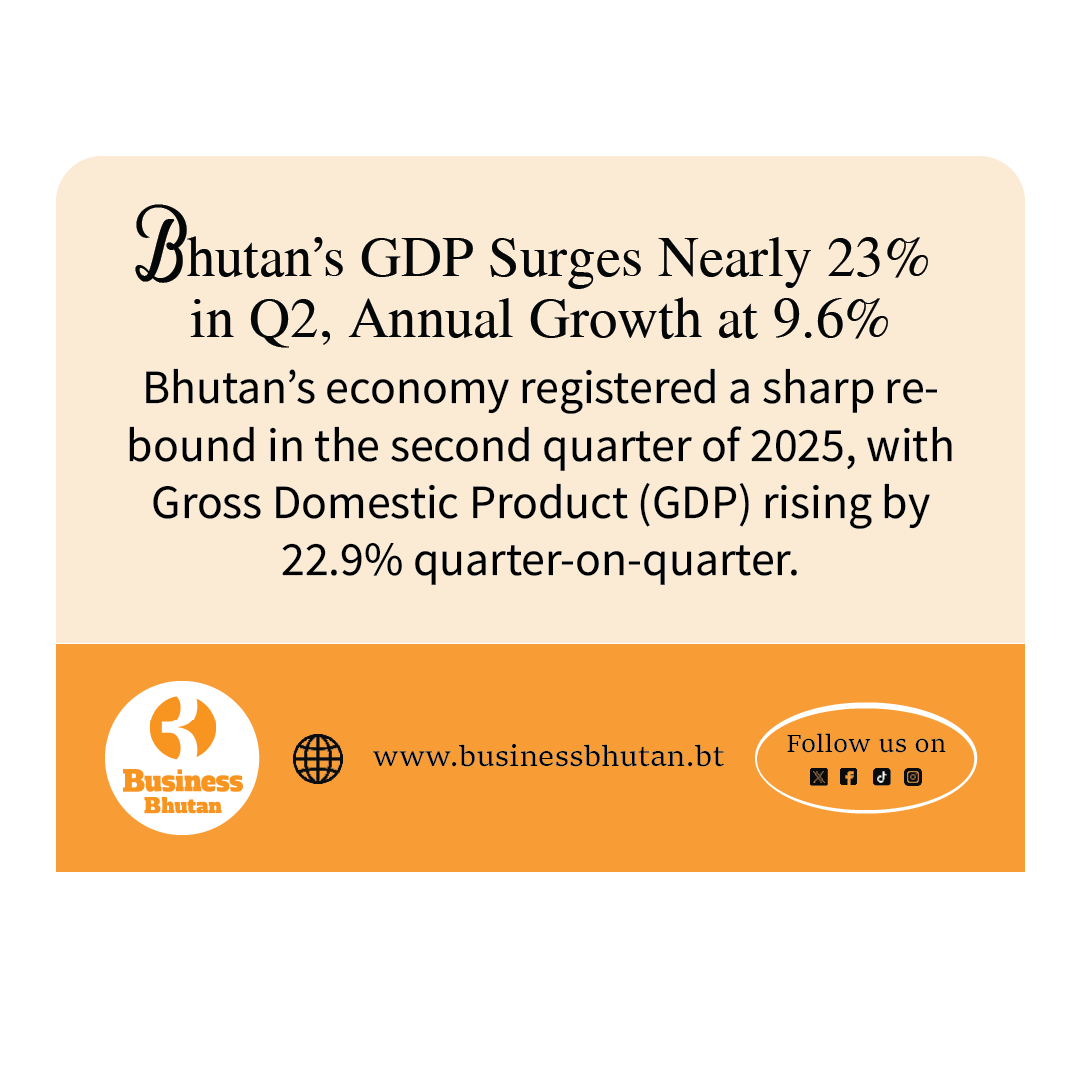
Bhutan’s economy registered a sharp rebound in the second quarter of 2025, with Gross Domestic Product (GDP) rising by 22.9% quarter-on-quarter. The total value of goods and services produced during the period reached Nu 77.89 billion, up by Nu 14.49 billion from Nu 63.40 billion in the first quarter, according to the National Statistics Bureau’s (NSB) quarterly GDP report.
On a year-on-year basis, GDP expanded by 9.63%, up from 7.03% in the same quarter last year, reflecting broad-based growth across sectors. Analysts attribute the strong performance to the sustained momentum in services and industry, with agriculture growing modestly but losing relative weight in the overall economy.
The agriculture sector, which includes crops, livestock, and forestry, recorded a growth of 3.07% in the second quarter. Its total value stood at Nu 10.053B, contributing roughly 13 percent to the overall GDP. However, despite this positive growth, the sector’s share in GDP decreased by 0.91 percentage points compared to the same quarter of 2024, mainly due to seasonal variations and fluctuations in production levels.
The industry sector showed one of the strongest performances, recording a growth of 12.97%. It accounted for 32.07% of GDP in the second quarter, up from 31.13 percent in the same period last year. The Gross Value Added (GVA) of the industry sector was estimated at Nu 24.984B, reflecting significant expansion in activities such as mining, manufacturing, electricity, and construction.
The services sector, including taxes less subsidies, continued to dominate the country’s economic landscape. It contributed the largest share at 55.02% of GDP, with a GVA of Nu 42.857B. Although its share fell slightly from 55.05% recorded in the second quarter of 2024, the sector remains the backbone of the country’s economy, driven by activities such as retail, trade, finance, public administration, and tourism.
The second quarter’s performance is seen as a promising sign for Bhutan’s broader economic ambitions. Under Bhutan’s 21st Century Economic Roadmap – A 10X National Economic Vision, the country aims to increase its GDP to USD 22 billion by 2050. To meet this ambitious target, the economy must grow at an annual rate of at least eight percent.
The government has outlined plans to achieve this through investments in both traditional and emerging sectors, including hydropower, tourism, and agriculture, digital economy, manufacturing, and mining.
The agriculture sector, though shrinking in relative share, remains crucial. The government intends to transform the sector into a high-value, resilient industry by focusing on organic production and export. This transformation is projected to contribute 3–4 percent to GDP growth.
The country plans to expand its hydropower generation capacity to 25,000 megawatts by 2050. This sector alone is expected to contribute between 12 and 15 percent to GDP while creating around 45,000 new jobs under the sector by 2050.
The tourism sector will continue to play a central role in the country’s development strategy. The sector aims to position the country as a premier destination for cultural, adventure, and nature-based tourism. By 2050, tourism is expected to generate over 80,000 jobs, while contributing 12 percent to GDP.
Bhutan also seeks to establish a vibrant digital economy. The government has set ambitious goals to create two “unicorn” companies, a start-ups valued at over USD 1 billion and foster 75 new ventures annually. This sector is projected to account for about 15 percent of GDP in the long run.
Additionally, Bhutan plans to attract global corporations through Business Process Outsourcing (BPO). The country also envisions becoming a research hub where multinational firms conduct studies and innovation, contributing around 12 percent to GDP.
Beyond hydropower, the government is also plans to diversify into solar and wind power, reinforcing its commitment to clean energy.
Under the manufacturing sector, they will focus on pharmaceuticals, electric vehicles, and robotics to boost innovation and value addition. By 2050, manufacturing is expected to contribute around 15 percent to GDP.
The government will also try to explore rare earth minerals, ensuring value addition before export to maximize economic returns. Analysts say that the nearly 23% quarter-on-quarter surge in GDP reflects strong recovery momentum but also highlights seasonal and base effects, with agriculture showing cyclical volatility. Services remain dominant, though the relative rise of industry suggests a gradual rebalancing of Bhutan’s growth drivers.
“The government’s roadmap is ambitious, requiring large-scale investments, innovation, and private sector participation,” said one analyst from Thimphu. “Risks remain, particularly in managing external demand (for tourism and hydropower exports), financing large infrastructure, and building human capital for high-tech and service industries.”
Meanwhile, experts reaffirmed that if executed effectively, Bhutan’s growth strategy could transform its economy from one reliant on hydropower and tourism into a diversified, innovation-driven economy aligned with sustainability and GNH.
Nidup Lhamo from Thimphu