

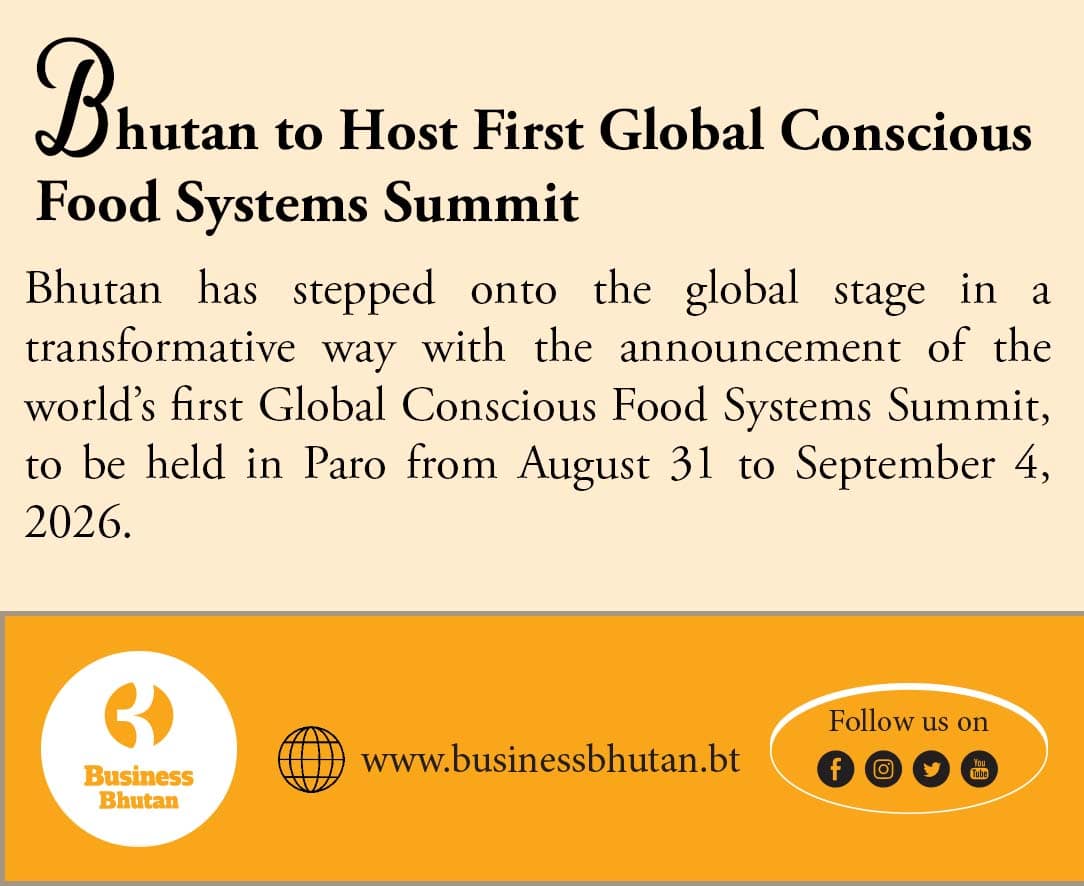
Bhutan has stepped onto the global stage in a transformative way with the announcement of the world’s first Global Conscious Food Systems Summit, to be held in Paro from August 31 to September 4, 2026. Jointly organized by the Royal Government of Bhutan, the United Nations Development Programme (UNDP), and the Conscious Food Systems Alliance, the summit represents a decisive effort to shift international conversations on food security toward a more holistic, human-centered framework.
The initiative marks a strategic inflection point for global food governance. While traditional food system summits emphasize technology, policy reforms, and economic efficiency, Bhutan’s approach places human consciousness, cultural values, and spirituality at the heart of transformation. This reflects the growing recognition among global institutions that the current trajectory—defined by climate crises, biodiversity collapse, and widening socio-economic inequality—cannot be resolved by technical interventions alone. The summit positions Bhutan as a leader in articulating a new paradigm for food systems, one rooted in a relational understanding between people, nature, and culture.
UNDP highlights this urgency: food systems are now under unprecedented stress, with climate-induced disruptions and ecological degradation outpacing the capacity of existing solutions. Technological innovation remains crucial, but without shifts in mindset and values, reforms will lack depth and durability. By foregrounding inner awareness and cultural consciousness, Bhutan is pushing the global community to address the underlying drivers of unsustainable food systems—consumption patterns, disconnection from nature, and short-term economic incentives.
For Bhutan, the summit also carries important national significance. Agriculture remains the backbone of rural livelihoods, employing over 40 percent of the population. Yet, Bhutan’s agricultural landscape is shaped by structural constraints, including limited arable land—less than 3 percent of the country’s territory—and increasing climate-related risks such as erratic rainfall, flash floods, glacial melt, and soil erosion. These pressures are intensifying food security vulnerabilities at a time when Bhutan is seeking to diversify its economy and strengthen rural resilience.
The summit thus provides an opportunity for Bhutan not only to influence global discourse but also to accelerate its own transition toward regenerative agriculture, improved water management systems, and nutrition-focused food value chains. Prime Minister Tshering Tobgay underscored this at the summit’s launch event, noting that “In Bhutan, food is not merely a commodity; it is a relationship with nature and across generations.” This framing reflects Bhutan’s longstanding development philosophy grounded in harmony between ecological health and human well-being.
The Prime Minister warned that climate change and soil degradation are already affecting the country’s food production capacity. To address this, the government is prioritizing soil rejuvenation, watershed revitalization, and support for farmers adopting climate-smart and regenerative practices. He also stressed the importance of inclusivity, calling for meaningful participation from farmers and youth in shaping the future of food systems. This emphasis aligns with Bhutan’s broader strategy to empower rural communities and ensure that policy decisions reflect realities on the ground.
The summit itself is designed to bring together an unusually diverse group of participants. Beyond policymakers and technical experts, the gathering will include farmers, Indigenous leaders, private sector representatives, civil society actors, researchers, and international agencies. It will also feature artists, storytellers, media professionals, and spiritual leaders—reflecting the belief that narratives, cultural memory, and spiritual traditions are powerful tools for shaping food systems transformation.
UNDP describes the summit as a platform for “high-level dialogue blended with grassroots insight,” underscoring the intent to break down the silos that have long divided technical discussions from cultural and spiritual perspectives. By convening multiple forms of knowledge from across the world—scientific, indigenous, artistic, and spiritual—the summit seeks to create a richer understanding of what sustainable and conscious food systems can look like.
Importantly, the summit is not an isolated event but part of a larger participatory process. A series of consultations, learning exchanges, and collaborative engagements are planned throughout 2026, ensuring that the dialogue extends beyond Paro and influences global, regional, and national policymaking. Organizers emphasize that the inaugural summit aims to be as inclusive as possible, though they acknowledge the logistical and financial constraints of bringing diverse communities together in the current global context.
Analytically, the summit appears poised to reposition Bhutan within global sustainability leadership. By championing consciousness-based approaches, Bhutan is introducing a distinctive intellectual and philosophical contribution to global governance. This aligns with the country’s soft power strategy: leveraging its reputation for environmental stewardship, cultural depth, and values-based governance to shape emerging international agendas.
The summit is expected to catalyze collective action, strengthen cross-sector collaboration, and attract investment into food systems that prioritize ecological integrity, social justice, and well-being. For Bhutan, the benefits could be significant: increased global visibility, expanded networks for agricultural innovation, deeper support for climate adaptation, and strengthened rural livelihoods.
Following the global launch, official registration for the summit is now open. Interested participants, including private sector actors, innovators, and food system practitioners, can register through the Conscious Food Systems Alliance portal. As momentum builds, Bhutan’s role in shaping the future of global food discourse looks set to grow—anchored in a belief that food is not merely sustenance, but a profound relationship linking people, culture, and the natural world.
Nidup Lhamo
From Thimphu