

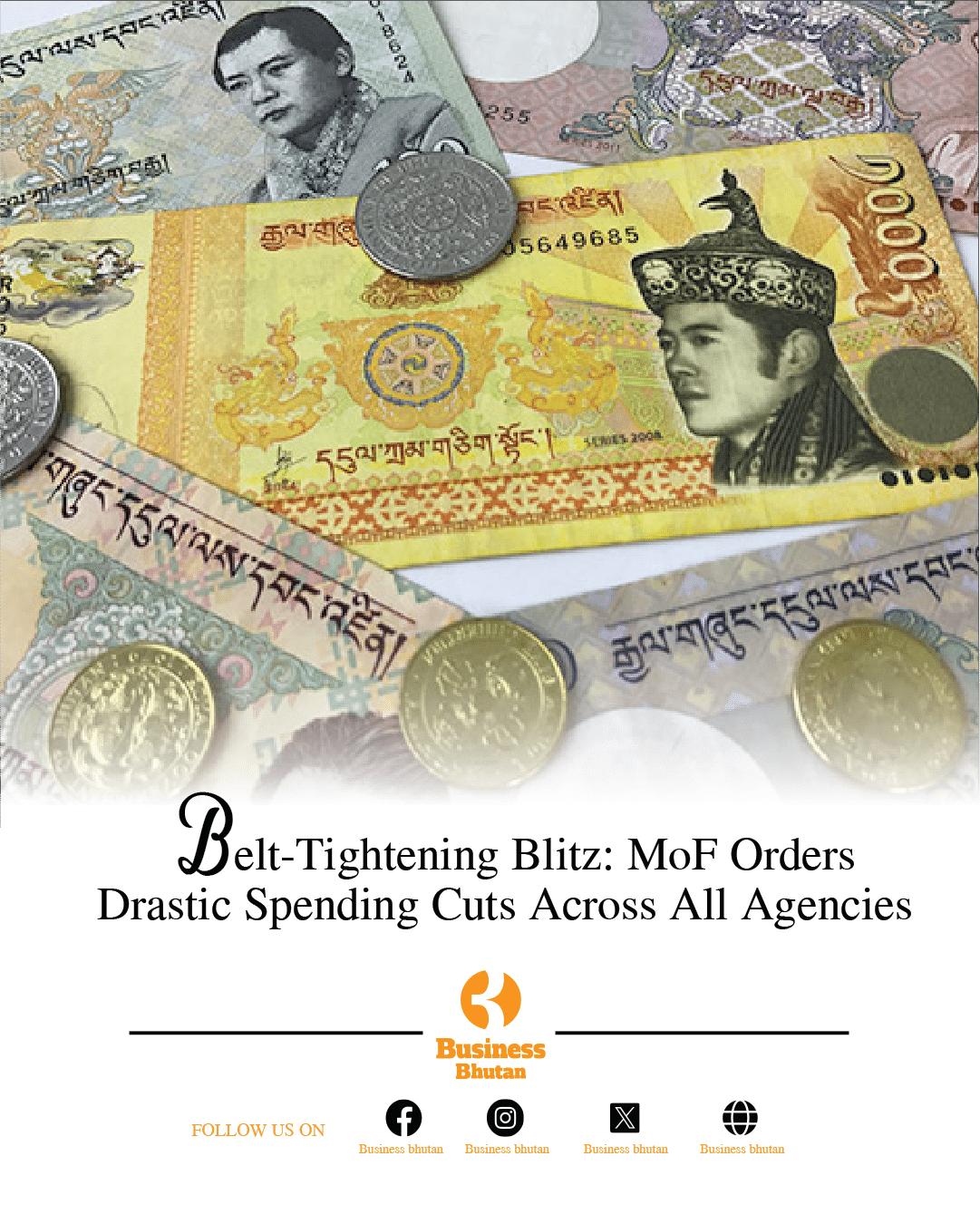
The Ministry of Finance (MoF) has introduced a sweeping set of cost-control measures, effective 1st December 2025, aimed at tightening expenditure, improving fiscal discipline, and promoting digital and resource-efficient practices across all government agencies.
The MoF stated that several agencies had misunderstood the expenditure ceilings for joining ceremonies issued in 2023–24, treating them as mandatory entitlements. The ministry clarified that these ceilings were never additional budget allocations but maximum limits within existing controllable budgets. This misinterpretation, it noted, had contributed to inconsistent and unnecessary spending in recent years.
Under the revised guidelines, expenditures for joining ‘dhar’ ceremonies for position holders at EX 3A and above—including Members of Parliament (MP), constitutional heads, judges, local government leaders, and heads of autonomous bodies—are now strictly limited to serving ‘zhudray phuentsum’ and ‘suja desi’ within office premises.
The rule applies to both new appointments and transfers but excludes promotions within the same department. The circular supersedes earlier MoF notifications, including those governing joining and ‘dakyen’ ceremonies for the Prime Minister, Cabinet Ministers, and equivalent positions.
Consecration and inaugural expenses will now be allowed only for major public infrastructure projects of national importance. Inaugurations for staff housing and designated residences are no longer permitted under any funding source.
To advance digitalization and reduce paper consumption, agencies must discontinue printing annual, quarterly, and monthly reports, making all publications accessible online instead. Duplex printing must be set as the default option, color printing restricted, and printer procurement rationalized through consolidation.
The MoF also reinforced existing carpooling rules for in-country travel. Officials attending the same program must travel together, and daily allowance (DA) claims are now limited based on distance, duration, and feasibility of same-day return. “Travel allowance is permitted only when the venue is more than 10 kilometers from the workplace and when no official transport is arranged,” the circular states.
On foreign travel, Human Resource Committees have been instructed to strictly limit government-funded study tours, workshops, and seminars. Agencies are encouraged to use Bhutanese diplomats stationed abroad to represent them at necessary international meetings. Officials eligible for business class travel are prohibited from upgrading donor-funded economy tickets.
Refreshments for internal meetings will no longer be provided unless approved by the agency head or required for foreign delegations. Agencies hosting the same delegation must coordinate with the Ministry of Foreign Affairs and External Trade and the MoF to avoid duplication. Alcohol, when deemed necessary, must be locally produced and cost less than the meals served.
The new measures also impose stricter controls on training, conferences, and workshops. Government facilities must be utilized wherever possible, virtual platforms adopted when appropriate, and events organized at locations where most participants are based. Domestic training institutions must be used for short-term programs, while foreign training will be permitted only when no local equivalent exists and the need is properly justified.
To reduce unnecessary expenditure, agencies must limit awareness and advocacy programs by leveraging digital platforms and local government networks. The procurement of non-essential extension kits—including tents, sleeping bags, rucksacks, boots, and camping equipment—is now prohibited without prior approval from the MoF, irrespective of funding source. Agencies are also barred from providing prize money, cash support, or free toolkits without explicit MoF authorization.
Citing rising fuel and maintenance costs, which have increased by about 10% annually, the MoF reiterated that designated pool vehicles must be used strictly for official purposes, while surrendered vehicles will no longer be redeployed.
Government officials will not be issued multiple laptops or desktops, and replacements will require verification from ICT and procurement officers to confirm genuine need and absence of negligence.
The ministry emphasized that these measures are consistent with its mandate under the Public Finance Act 2007 to ensure prudent management of limited public resources. The new directives supersede the circular issued on 1st September 2022 and come into full effect starting 1st December 2025.
The MoF called on all agencies to uphold both the “principle and spirit” of the reforms to strengthen fiscal discipline and maximize the effective use of public funds
The Ministry of Finance (MoF) has introduced a sweeping set of cost-control measures, effective 1st December 2025, aimed at tightening expenditure, improving fiscal discipline, and promoting digital and resource-efficient practices across all government agencies.
The MoF stated that several agencies had misunderstood the expenditure ceilings for joining ceremonies issued in 2023–24, treating them as mandatory entitlements. The ministry clarified that these ceilings were never additional budget allocations but maximum limits within existing controllable budgets. This misinterpretation, it noted, had contributed to inconsistent and unnecessary spending in recent years.
Under the revised guidelines, expenditures for joining ‘dhar’ ceremonies for position holders at EX 3A and above—including Members of Parliament (MP), constitutional heads, judges, local government leaders, and heads of autonomous bodies—are now strictly limited to serving ‘zhudray phuentsum’ and ‘suja desi’ within office premises.
The rule applies to both new appointments and transfers but excludes promotions within the same department. The circular supersedes earlier MoF notifications, including those governing joining and ‘dakyen’ ceremonies for the Prime Minister, Cabinet Ministers, and equivalent positions.
Consecration and inaugural expenses will now be allowed only for major public infrastructure projects of national importance. Inaugurations for staff housing and designated residences are no longer permitted under any funding source.
To advance digitalization and reduce paper consumption, agencies must discontinue printing annual, quarterly, and monthly reports, making all publications accessible online instead. Duplex printing must be set as the default option, color printing restricted, and printer procurement rationalized through consolidation.
The MoF also reinforced existing carpooling rules for in-country travel. Officials attending the same program must travel together, and daily allowance (DA) claims are now limited based on distance, duration, and feasibility of same-day return. “Travel allowance is permitted only when the venue is more than 10 kilometers from the workplace and when no official transport is arranged,” the circular states.
On foreign travel, Human Resource Committees have been instructed to strictly limit government-funded study tours, workshops, and seminars. Agencies are encouraged to use Bhutanese diplomats stationed abroad to represent them at necessary international meetings. Officials eligible for business class travel are prohibited from upgrading donor-funded economy tickets.
Refreshments for internal meetings will no longer be provided unless approved by the agency head or required for foreign delegations. Agencies hosting the same delegation must coordinate with the Ministry of Foreign Affairs and External Trade and the MoF to avoid duplication. Alcohol, when deemed necessary, must be locally produced and cost less than the meals served.
The new measures also impose stricter controls on training, conferences, and workshops. Government facilities must be utilized wherever possible, virtual platforms adopted when appropriate, and events organized at locations where most participants are based. Domestic training institutions must be used for short-term programs, while foreign training will be permitted only when no local equivalent exists and the need is properly justified.
To reduce unnecessary expenditure, agencies must limit awareness and advocacy programs by leveraging digital platforms and local government networks. The procurement of non-essential extension kits—including tents, sleeping bags, rucksacks, boots, and camping equipment—is now prohibited without prior approval from the MoF, irrespective of funding source. Agencies are also barred from providing prize money, cash support, or free toolkits without explicit MoF authorization.
Citing rising fuel and maintenance costs, which have increased by about 10% annually, the MoF reiterated that designated pool vehicles must be used strictly for official purposes, while surrendered vehicles will no longer be redeployed.
Government officials will not be issued multiple laptops or desktops, and replacements will require verification from ICT and procurement officers to confirm genuine need and absence of negligence.
The ministry emphasized that these measures are consistent with its mandate under the Public Finance Act 2007 to ensure prudent management of limited public resources. The new directives supersede the circular issued on 1st September 2022 and come into full effect starting 1st December 2025.
The MoF called on all agencies to uphold both the “principle and spirit” of the reforms to strengthen fiscal discipline and maximize the effective use of public funds.
Nidup Lhamo
From Thimphu