

As Bhutan prepares to implement the Goods and Services Tax (GST) from 1 January 2026, automobile dealers are raising urgent calls for justice, seeking either a refund or adjustment of the green tax they paid for 2025. With the new GST system set to replace the green tax, dealers warn that failing to address the issue could result in what they describe as “triple taxation” on imported vehicles.
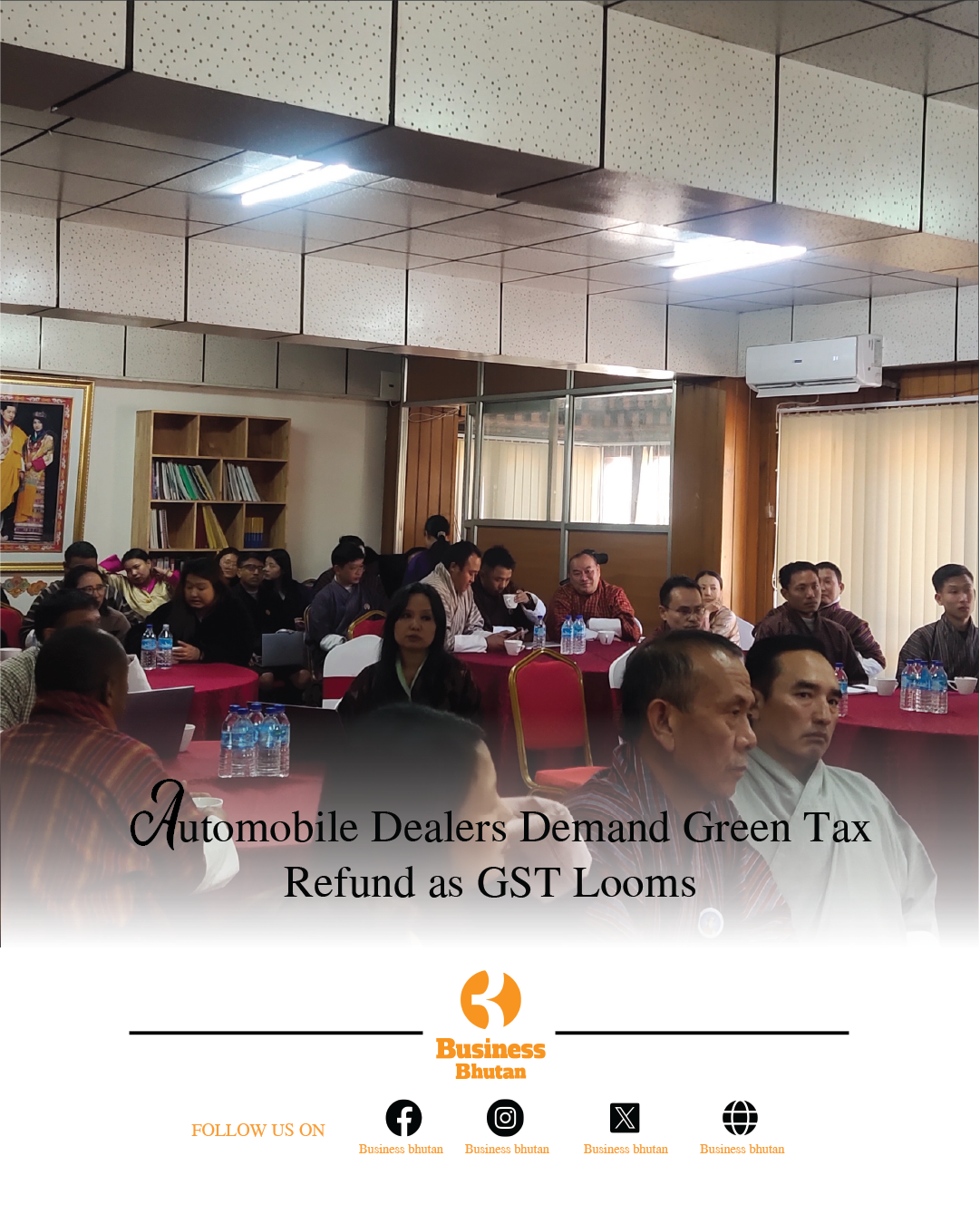
Some dealers had already paid 10% green tax before the GST rollout, expecting it to be part of the country’s ongoing tax structure. “Government should either refund the green tax we have already paid or not levy the 5% GST on these vehicles,” said Ugyen Dorji, Regional Manager for Mahindra Bhutan (Singye Agencies), during a stakeholder meeting organized by the Bhutan Chamber of Commerce and Industry on 12 December 2025. Other dealers echoed the same concern, emphasizing that without intervention, they face a significant financial burden.
To ease the transition, the government had previously established a warehouse facility for vehicle dealers. Under this system, licensed dealers could register as Warehouse Operators without conditions, deferring payment of customs duty, green tax, and other applicable taxes until the vehicle was sold or removed from the warehouse. This policy allowed dealers much-needed financial flexibility, enabling them to manage daily expenses, payroll, and inventory costs during periods of reduced sales.
However, dealers revealed that the warehouse facility is set to be discontinued with the GST implementation, leaving them without a mechanism to offset previously paid green taxes. “If the government does not refund the green tax, it should continue with the warehouse system,” urged Ugyen Dorji, emphasizing that such continuity could serve as an effective adjustment and safeguard dealer liquidity.
In addition, dealers propose that excise duties be collected at the point of sale rather than at import. Before GST, the green tax was levied at the point of entry, while Bhutan Sales Tax (BST) was collected at sale. Aligning excise duty with the point of sale, they argue, would simplify cash flow management, reduce administrative burdens, and make business operations more predictable.
The green tax, introduced in 2012, was designed to curb vehicular emissions and encourage electric vehicle adoption, reinforcing Bhutan’s carbon-negative status. It is levied on motor vehicles and petroleum fuels based on engine type and capacity. While the tax has contributed to environmental objectives, it has faced criticism for creating financial strain on citizens and, in some cases, instances of overcharging by dealers. Recent government measures to reduce vehicle taxes aim to make personal transportation more affordable and stimulate economic activity.
With the GST, Bhutan is moving to a uniform 5% tax rate on most goods and services, exempting essentials like rice, salt, cooking oil, sanitary pads, wheelchairs, and services related to health, education, finance, and exports. Electricity will also attract the 5% rate, but rural households will continue to enjoy subsidies on the first 100 units. These reforms are intended to simplify the tax system, reduce compliance complexity, and create a more transparent and streamlined process for businesses and consumers alike.
For automobile dealers, the stakes are high. Without timely intervention on the green tax issue or continuation of the warehouse system, dealers fear that margins will be squeezed, cash flows strained, and business operations disrupted—particularly in the context of rising import volumes ahead of the GST rollout. Stakeholders have urged the government to consider their proposals seriously, framing the discussion as a matter of fairness and business survival, as Bhutan navigates the transition to a modern, simplified tax regime.
As the GST countdown begins, the resolution of the green tax dilemma could set a precedent for how Bhutan balances fiscal reform, environmental policy, and the needs of private businesses. Dealers, the government, and consumers alike are watching closely, recognizing that timely action is crucial to ensuring that the shift to GST is not only efficient but also equitable.
Sangay Rabten
From Thimphu